
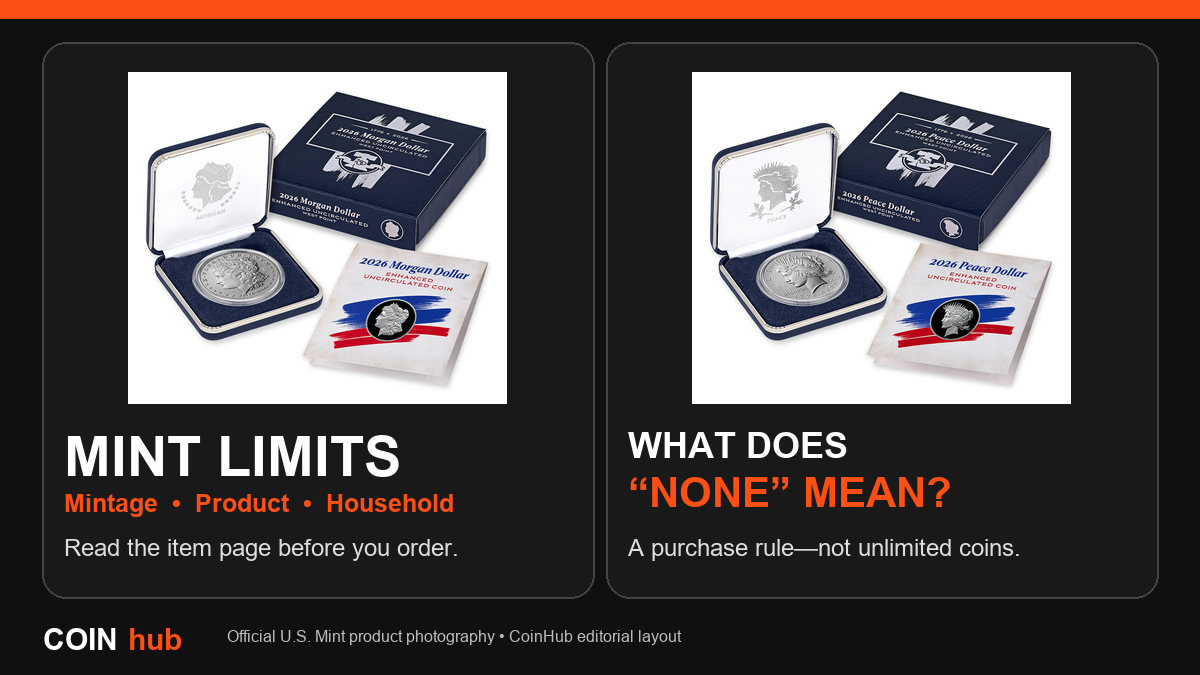
A U.S. Mint listing can show several different limits at once. They are useful buying information, but they do not all describe the same thing—and none of them alone guarantees rarity or future value.
When a Mint release draws attention, collectors often see three labels grouped together: Mintage Limit, Product Limit, and Household Order Limit. Reading them as interchangeable can lead to a bad assumption about how many coins exist, how many units of a particular product can be sold, or how many one buyer can order. Here is a practical five-part way to read the page.
1. Mintage limit: the cap tied to the coin itself
A mintage limit is the maximum number of coins the Mint says it plans to strike for that coin or issue. It is the label closest to “how many physical coins may exist,” but it is still not a grade, survival, demand, or resale-value forecast.
The important detail is that a single coin design can sometimes appear through more than one product channel. In that situation, the mintage limit is the broader coin-level number; it is not automatically the count for the specific SKU sitting in your cart.
2. Product limit: the cap for one listing or SKU
A product limit applies to the particular product being sold. It can match the mintage limit, as it does on the Mint’s current 2026 Morgan Enhanced Uncirculated Dollar listing, where both figures are 250,000. But matching numbers should be read as a fact about that listing—not as a rule for every Mint release.
For a set, roll, bag, or product that shares coins with other offerings, the product limit can be narrower than the total number of coins struck. Start with the item number, then read the limit labels beside that item rather than borrowing a number from a related listing.
3. Household order limit: a purchase rule, not a mintage
The household order limit is the maximum quantity the Mint currently allows one household to purchase. It is a fairness and distribution control. It does not mean only that many pieces exist, and it does not establish a buyer’s place in line after a product has sold out.
For example, the current 2026 Morgan Enhanced Uncirculated Dollar page shows Household Order Limit: None while still showing 250,000 as both its mintage and product limit. The Mint’s Help Center also notes that household limits are typically lifted one business day after release and may be implemented as the Mint monitors a product. Recheck the live product page immediately before ordering.
4. “None” means no listed cap in that field—not zero
On a Mint product page, None under household order limit means the page is not imposing a household purchase cap at that time. It does not mean there are no coins, no product cap, or unlimited production. The current 2026 Liberty Bell one-ounce gold coin is a clear reminder: it lists no household order limit but still lists mintage and product limits of 2,026.
Read every field separately. A shopper can see “None” in one row and a fixed number in the rows above it without any contradiction.
5. “TBD,” availability, and a sellout are separate status signals
Some upcoming Mint pages show a value as TBD, and a live page can change from available to unavailable without changing the historical meaning of a stated mintage or product limit. “TBD” means the listing has not supplied that figure yet. “Unavailable” or “sold out” describes the present sales status. Neither phrase, by itself, proves the final mintage or a future market price.
For time-sensitive releases, use the Mint’s current product page and its product schedule as the final check. The schedule itself warns that dates and prices may change.
A 30-second Mint-limit checklist
- Confirm the exact item number and product name.
- Read mintage limit as the coin-level cap, if one is listed.
- Read product limit as the cap for that SKU or offering.
- Read household order limit as the current purchasing rule.
- Check whether any field says “None,” “TBD,” or has changed since you last looked.
What these limits do not tell you
Limit labels do not tell you the condition of a future coin, how many buyers want it, how many pieces will be saved, or what the secondary market will pay. They are a starting point for comparing official Mint offerings—not a shortcut to a value prediction. If a price decision matters to you, keep the official listing, the product specifications, and the final sales information separate from speculation.
Frequently asked questions
Is a product limit the same as a mintage limit?
Sometimes the figures are the same on a specific listing, but they describe different things. A mintage limit concerns the coin issue; a product limit concerns the number of units offered through that product listing.
Does “no household order limit” mean unlimited coins?
No. It means the Mint is not currently imposing a household purchase cap. The page may still list a mintage limit and product limit.
Can the Mint change a household order limit?
Yes. The Mint’s Help Center says limits are typically lifted one business day after release and may be implemented as products are monitored. Always recheck the live listing.
Sources: U.S. Mint Morgan Silver Dollar 2026 Enhanced Uncirculated Coin (26XE); U.S. Mint Freedom Ringing – Liberty Bell One Ounce Gold Coin (26LB); U.S. Mint Help Center; U.S. Mint 2026 Product Schedule.