
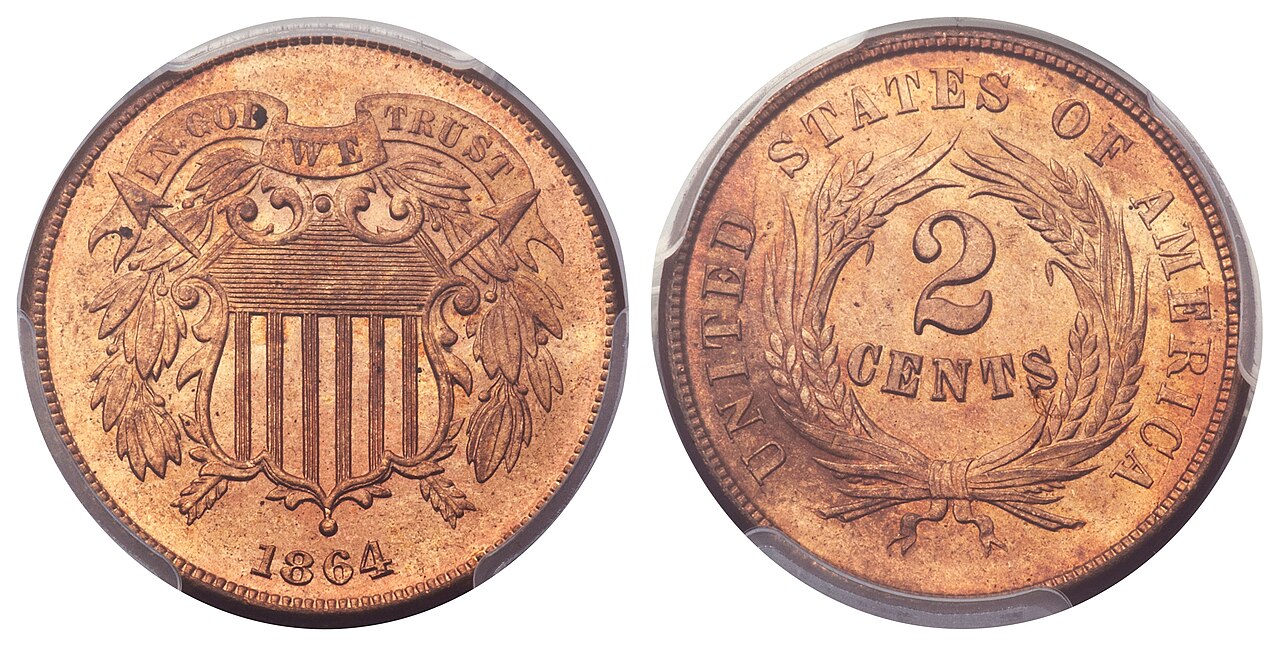
What Is a Two-Cent Piece?
The two-cent piece is one of the more interesting short-run denominations in United States coinage. It was introduced during the Civil War, when people were hoarding silver and gold coins and even small change could be hard to find in daily commerce. The Mint needed practical minor coins, and the two-cent piece gave the public a larger bronze coin that could help move small transactions along.
Collectors also remember it for a major design first: the two-cent piece was the first regular-issue U.S. coin to carry the motto IN GOD WE TRUST. The obverse shows a shield with arrows and laurel branches, while the reverse shows the denomination 2 CENTS inside a wheat wreath. It is a compact coin, but the design has a heavy Civil War look that makes it stand out in a type set.
All regular two-cent pieces were struck at the Philadelphia Mint, so there is no mint mark to find. If you see a two-cent piece listed with a mint mark, treat that as a red flag or a listing mistake.
Two-Cent Piece Specifications
| Feature | Collector Detail |
|---|---|
| Denomination | Two cents, or 0.02 U.S. dollars |
| Designer | James B. Longacre |
| Metal | Bronze: 95% copper with 5% tin and zinc |
| Weight and diameter | 6.22 grams and 23 millimeters |
| Edge | Plain edge |
What Is a Two-Cent Piece Worth?
Most two-cent pieces are worth more than two cents, but the range is wide. A problem-free common date in lower circulated condition can often sell in the $20 to $75 area, depending on the date, detail, and surfaces. Sharper Extremely Fine or About Uncirculated coins can move into the low hundreds, while certified Mint State pieces can bring several hundred dollars or more.
The biggest jump comes from scarce dates, scarce varieties, and original color. Bronze coins are described as Brown, Red-Brown, or Red. Full Red examples are harder to find because copper changes color over time. A red certified two-cent piece can sell for a large premium compared with a brown coin of the same date and grade.
| Coin or Group | Value Notes |
|---|---|
| Common circulated dates | Often collectible in the $20-$75+ range when problem-free, with better detail bringing more. |
| 1864 Large Motto | The common first-year variety, popular for type collectors and Civil War history. |
| 1864 Small Motto | The key variety from 1864. Even worn examples can bring strong premiums when correctly attributed. |
| 1872 | The lowest-mintage regular circulation strike at 65,000 pieces, and a major date in the series. |
| 1873 proofs | Collector-only proof issues with Open 3 and Closed 3 varieties. These are not pocket-change coins. |
Use any price guide as a starting point, not a final offer. PCGS, NGC, auction records, and current dealer listings can differ because grading, eye appeal, color, and surface problems change the real market result.
Key Dates and What to Check
The first thing to check is the date. The series ran from 1864 to 1873, but only 1864 through 1872 were made for circulation. The 1873 two-cent piece was struck for collectors as a proof issue.
For 1864, look closely at the motto IN GOD WE TRUST. The scarce Small Motto has smaller, thinner lettering, while the Large Motto has taller and more prominent lettering. The difference can be subtle if you are looking at a worn or poorly photographed coin, so compare with certified images before assuming you have the better variety.
The 1872 issue is the big regular-issue date because only 65,000 were struck for circulation. Many collectors building a full set need it, which keeps demand strong. The 1870 and 1871 dates are also lower-mintage coins compared with the early years, but the 1872 is the headline circulation key.
Common Mistakes Collectors Make
- Assuming every two-cent piece is rare: The type is historic, but common-date worn examples are available.
- Ignoring surface problems: Corrosion, pitting, cleaning, rim damage, and dark environmental spots can cut value sharply.
- Misreading the 1864 motto: Small Motto and Large Motto attribution should be checked against clear reference images.
- Looking for a mint mark: Two-cent pieces were struck at Philadelphia and do not carry a mint mark.
- Cleaning the coin: Cleaning a copper or bronze coin can permanently damage the surface and reduce collector value.
Should You Get One Graded?
Grading makes the most sense when the coin is a better date, an 1864 Small Motto candidate, a proof, a high-grade piece, or a coin with unusually strong original color. If the coin is a common date with heavy wear and surface damage, grading fees can cost more than the extra value gained from a holder.
If you think you have a valuable example, take clear photos of the full obverse, full reverse, date, motto, and surfaces. Handle the coin by the edges only, place it in a non-PVC holder, and avoid rubbing the brown or red-brown surfaces. For higher-value examples, PCGS or NGC authentication can help buyers trust the variety, grade, and color designation.
CoinHub tip: A two-cent piece is worth slowing down for because the value depends on details. Check the date first, confirm there is no mint mark, study the 1864 motto if applicable, and never clean the coin. If it looks like an 1864 Small Motto, 1872, or proof 1873, authentication is usually the smarter move before selling.
Research checked against PCGS price guide data, NGC Coin Explorer, Wikimedia Commons imagery, U.S. two-cent piece historical references, and current public collector value guides. Values can change with grade, certification, color, eye appeal, and market demand.