
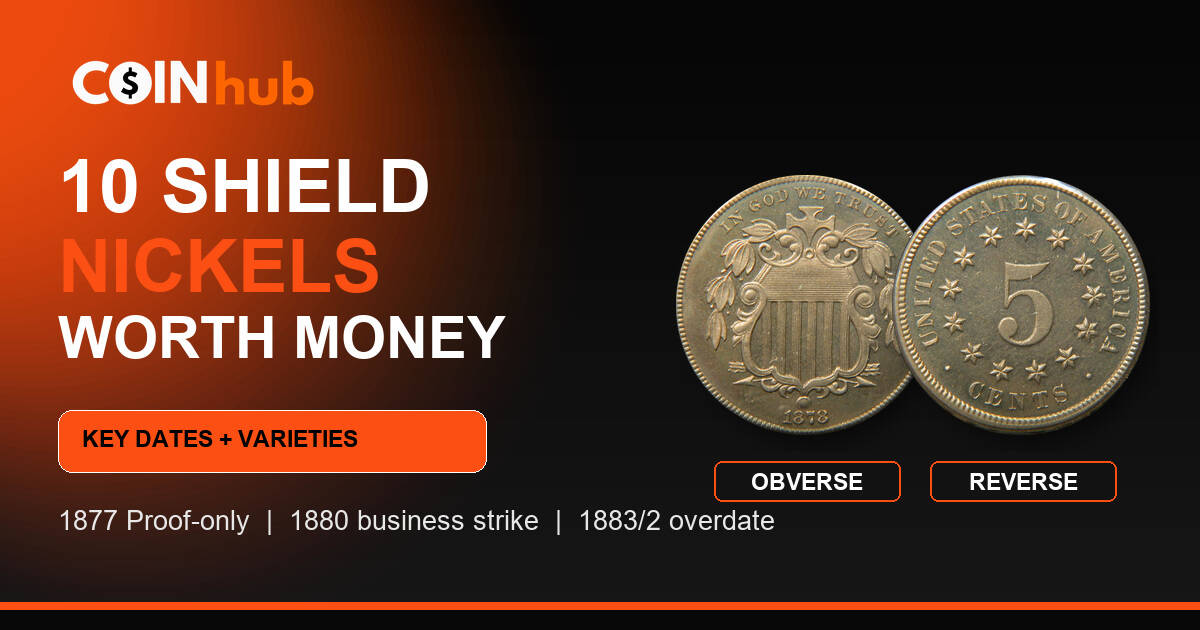
10 Shield Nickels Worth Money: Key Dates, Proof-Only Issues, and Varieties
The Shield nickels most worth checking first include the 1877 and 1878 proof-only issues, the 1880 business strike, the low-mintage 1879 and 1881 dates, and varieties such as the 1879/8 proof and 1883/2 overdate. Condition, originality, and certification matter a lot with this series.
Shield nickels were struck from 1866 to 1883 and were the first U.S. five-cent coins made from the familiar copper-nickel alloy. They are not modern pocket-change finds, but they do show up in old collections, type sets, estate boxes, and dealer bulk lots.
The biggest money in Shield nickels usually comes from proof-only dates, very low-mintage business strikes, high-grade examples, and properly attributed varieties. All regular Shield nickels were made at Philadelphia, so do not look for a mint mark. Look at the date, reverse style, strike quality, and whether the coin has been cleaned or damaged.
10 Shield Nickels Worth Checking
How To Identify A Better Shield Nickel
Start with the date. The strongest regular dates are 1879, 1880, and 1881, while 1877 and 1878 are proof-only issues. Then check the reverse: 1866 and part of 1867 have rays between the stars around the 5, while later coins do not.
For varieties, use magnification and compare the date carefully. The 1873 Closed 3, 1879/8, and 1883/2 need close inspection. A coin with heavy wear, corrosion, cleaning, or altered surfaces can still be collectible, but value can drop fast compared with an original certified example.
What Are Shield Nickels Worth?
Common circulated Shield nickels can be affordable type coins, but key dates and certified varieties can move into the hundreds or thousands of dollars. High-grade pieces, cameo proofs, and rare proof-only issues can sell for much more. Always check current PCGS or NGC price guides and recent auction records before buying, selling, or grading.
Common Mistakes To Avoid
Do not assume every old nickel is a rare one. Many Shield nickels have weak strikes, die cracks, corrosion, or cleaning. Also be careful with 1880 business strikes and proofs, because they can be confused. If the coin looks like a key date, overdate, or high-grade proof, third-party authentication is worth considering.
CoinHub tip: If you inherited old nickels, separate every Shield nickel by date before checking value. The date alone can make a huge difference, and the 1877, 1878, 1879, 1880, 1881, 1879/8, and 1883/2 pieces deserve a closer look.