
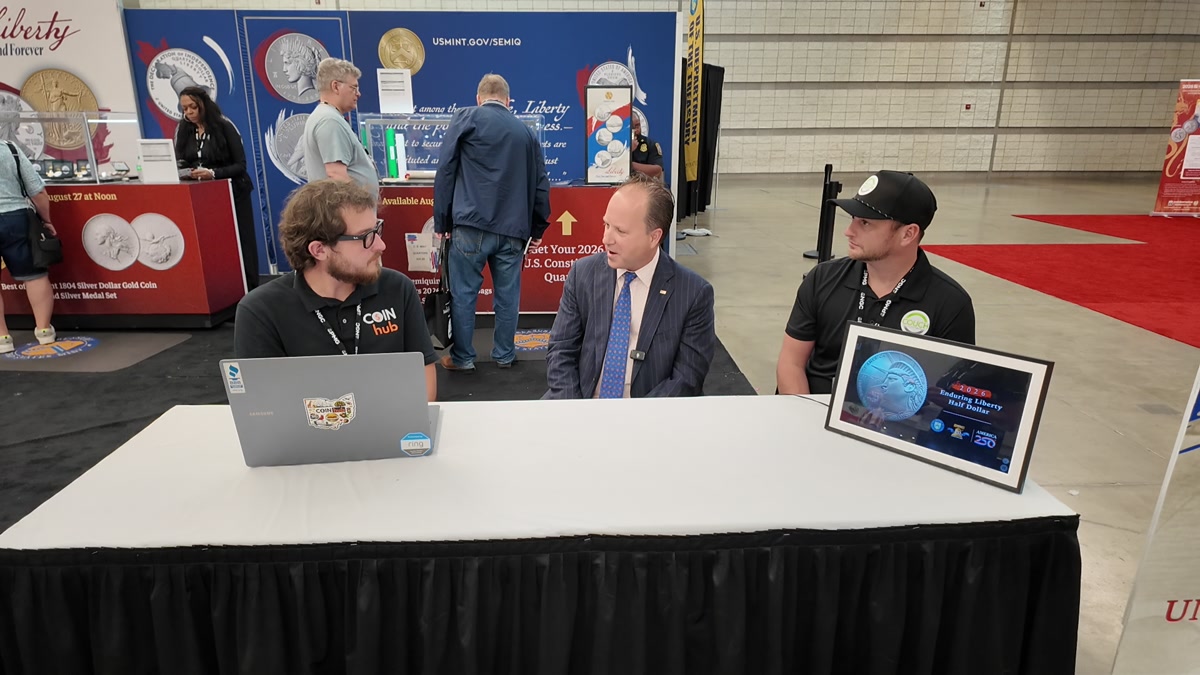
Could pennies reach the Moon and back? A face-to-face stack would need about 506 billion modern cents, using the Moon’s average distance and the Mint’s listed penny thickness. U.S. Mint Director Paul Hollis offers that striking comparison in his CoinHub interview. The math explains the scale of his claim. It does not show how many coins still exist or can be used as change.
Hollis says he looked at production figures going back to 1909 in the Red Book, a coin reference guide. He is talking about coins made over many years. That is a different question from how many cents are now moving through stores and banks. His talk with Blake Alma and Justin Couch of Couch Collectibles helps show why those counts matter.
Watch Hollis explain the comparison
The captioned excerpt is also available as the original CoinHub clip. Hollis speaks throughout this passage. Watch the full interview with Hollis, Alma and Couch for the wider discussion of pennies, coin designs and collecting.
“You could stack pennies to the moon and stack pennies back, and we’d have enough to do that.”
— Paul Hollis, CoinHub interview
Hollis puts the distance at about 240,000 miles and notes that it changes. He uses this image to make the case that many pennies already exist. The clip does not show his yearly sums, name a Red Book edition or give the final coin total he used. We can check the distance math, but we have not checked an unseen tally.
What a stack to the Moon would require
NASA lists the Moon’s average distance as 384,400 kilometers, or 238,855 miles. This is an average, not a fixed gap. Going there and back doubles that number to 768,800 kilometers. Here we use the published distance without adjusting for the sizes of Earth and the Moon. This simple model is not a plan for a real tower.
The Mint’s current coin measurements give the penny a thickness of 1.52 millimeters and a width, or diameter, of 19.05 millimeters. A stack grows by that thickness as each coin sits on the one below it. A row with the edges touching grows by the width of each coin.
To use the same units, multiply kilometers by one million to get millimeters. Then divide the trip length by the length each penny adds. For a stack, the calculation is 768,800,000,000 millimeters divided by 1.52 millimeters: about 505.8 billion coins, rounded to 506 billion.
| Arrangement | Length per coin | One way | There and back |
|---|---|---|---|
| Face-to-face stack | 1.52 mm | About 253 billion | About 506 billion |
| Edge-to-edge row | 19.05 mm | About 20.2 billion | About 40.4 billion |
These rounded sums use the listed size of a modern penny. They assume no gaps and do not model worn or bent coins. Put the same coins in a row and they cover more than twelve times as much length. That row is not the stack Hollis describes.
Coins made and coins available are different counts
A mintage is the number of coins made. Add those yearly numbers and you get a total for coins struck over time. Some can be lost, damaged, saved or kept out of daily use. Even a sound total for coins ever made would not show how many a local store can get today. The clip gives no separate count of pennies still in use.
Official sources also need dates and context. The Mint’s November 12, 2025 announcement used an estimate of 300 billion pennies in circulation. Treasury’s December 23, 2025 guidance refers instead to roughly 114 billion pennies in existence. These two dated figures differ. The pages do not show how they counted the coins or why the totals differ.
Neither figure reaches the roughly 506 billion needed for our face-to-face round-trip model. Neither page gives a sum for coins made since 1909. We cannot use them to check Hollis’s sum. His claim stays attributed to him. It should not be read as proof that today’s supply could make that round trip.
What collectors can take from the analogy
When you hear a very large coin number, ask what it counts. Does it mean coins made in one year, all coins ever struck, coins still around or coins still in daily use? Then ask how the math was done. The choice of thickness or width can change the result, even when both sums use the real size of a coin.
This is also separate from collector demand. A broad supply claim tells us little about a particular date, mint mark or condition. For Hollis’s comments on cents made for collectors, see our report on his answer to Justin Couch about collector sets. That story addresses a different question from how far a hypothetical stack would reach.
Reporting note: Quotes follow the approved CoinHub clip. The rounded math uses the official sizes linked above. It does not prove a total for all pennies ever made. The filming date is not known. Justin Couch appears with Alma and Hollis in the full talk; find Couch Collectibles on YouTube and Facebook.