
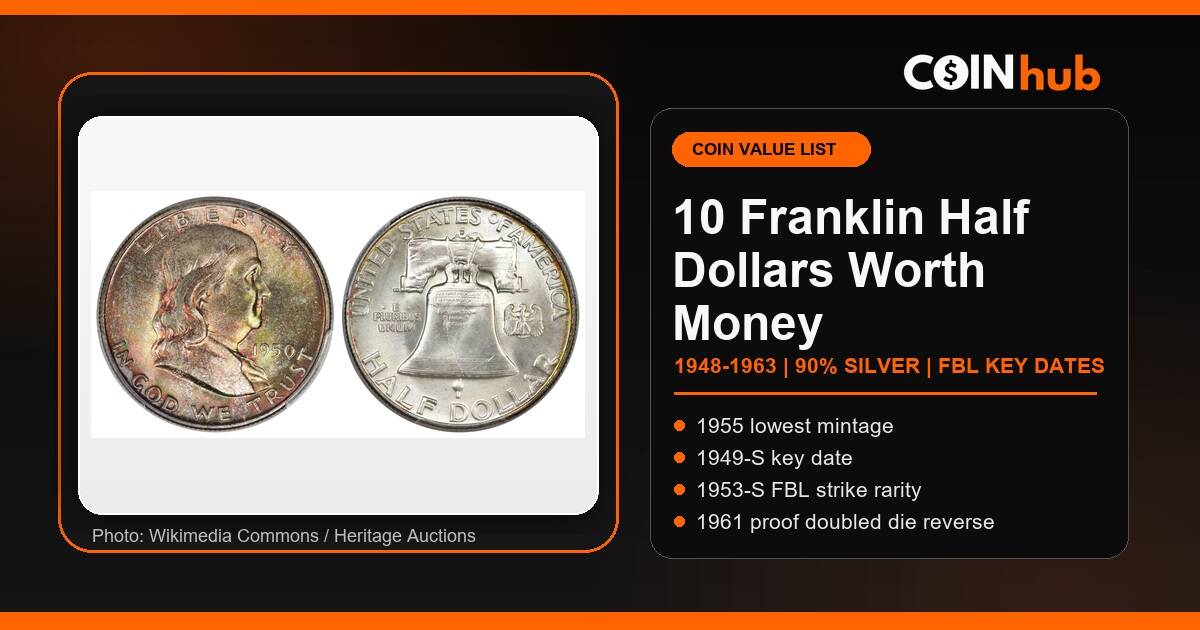
Franklin Half Dollar Key Dates, FBL Coins, and Proof Varieties
10 Franklin Half Dollars Worth Checking
Franklin half dollars are popular because the set is short, silver, and easy to understand at first glance. The challenge is that many dates are common unless the coin has the right mint mark, grade, strike, proof finish, or variety. Here are 10 Franklin halves that deserve a closer look before you sell or spend them.
11955 Franklin Half Dollar
The 1955 Philadelphia Franklin half dollar is the lowest-mintage regular issue of the series at 2,498,181 coins. Many examples are available, but it is still the date collectors quickly recognize. Check the reverse for Full Bell Lines and check the obverse near Franklin's mouth for the well-known 1955 "Bugs Bunny" die clash variety.
21949-S Franklin Half Dollar
The 1949-S is one of the key semi-key dates collectors watch. PCGS lists the mintage at 3,744,000, and strong Mint State coins can be tougher than the raw number might suggest. A clean 1949-S with sharp bell detail is much more interesting than a heavily worn example.
31953-S Franklin Half Dollar With Full Bell Lines
This is the big strike rarity of the circulation-strike Franklin series. Many 1953-S halves are weakly struck, especially on the Liberty Bell. If the horizontal bell lines are complete and distinct, the coin should be treated carefully and considered for professional grading.
41950 Proof Franklin Half Dollar
The 1950 proof is important because it is the first proof year of the Franklin half dollar series and has the lowest Franklin proof mintage. Cameo contrast, clean fields, and original surfaces matter. Proof Franklin halves can be hairlined easily, so avoid rubbing or wiping the surface.
51961 Proof Doubled Die Reverse Franklin Half Dollar
The 1961 proof doubled die reverse is one of the most famous Franklin varieties. Look on the reverse lettering, especially E PLURIBUS UNUM, UNITED STATES OF AMERICA, and HALF DOLLAR. Strong examples show visible doubling and should be authenticated because this is a variety collectors actively chase.
61956 Type 1 Proof Franklin Half Dollar
The 1956 Type 1 proof uses the earlier reverse hub and is less common than the Type 2 proof. It is not automatically rare in every grade, but high-grade cameo or ultra cameo pieces can stand out. The reverse style and proof surface quality are the keys.
71952-S Franklin Half Dollar
San Francisco Franklin halves often struggle with strike. A 1952-S with strong bell lines, clean fields, and attractive luster can be far better than an average weakly struck coin. If you are checking a roll or collection, this is one of the S-mint coins worth slowing down for.
81951-S Franklin Half Dollar
The 1951-S is another San Francisco issue where condition and strike make the difference. Circulated pieces are usually silver-value coins, but a bright, original, sharply struck example can be more collectible. Check the bell lines before assuming it is ordinary.
91950-D Franklin Half Dollar With Full Bell Lines
The 1950-D is an early Denver issue that can bring a premium when the strike is strong. The coin does not need to be rare in worn condition to be worth checking. The better opportunity is a Mint State example with clean surfaces and clearly separated bell lines.
101963-D Franklin Half Dollar in High Grade
The 1963-D had a large mintage, so most are not rare. Still, it was the final year of the Franklin half dollar, and high-grade pieces with strong Full Bell Lines can interest set builders. Do not confuse "last year" with automatic rarity, but do not ignore an exceptional example either.
How To Check Full Bell Lines
Flip the coin to the Liberty Bell side and look at the horizontal lines across the lower part of the bell. On a strong Full Bell Lines coin, those lines should be complete and clearly separated, not flat, blended, or broken by weak strike. Contact marks across the lines can also matter.
San Francisco issues are especially important to inspect because many were softly struck. A normal 1953-S is one thing. A 1953-S with true Full Bell Lines is a completely different conversation.
Common Mistakes To Avoid
- Do not value every Franklin half as rare just because it is silver. Many circulated examples trade mainly around silver content.
- Do not clean a proof or Mint State Franklin half. Hairlines can quickly reduce collector demand.
- Do not assume all bell lines are Full Bell Lines. Weak, partial, or damaged lines usually do not qualify.
- Do not rely on online asking prices alone. Actual sold prices, grade, and certification matter.
Are Franklin Half Dollars Worth Money?
Yes, but the reason matters. Every Franklin half dollar has 90% silver content, so silver price gives the common circulated coins a floor. Collector premiums usually come from key dates, scarce strike quality, proof cameo contrast, doubled dies, die clashes, or high certified grades.
If you think you have a major variety or a truly sharp Full Bell Lines coin, keep it in a safe holder and compare it with trusted grading references before selling. For stronger coins, PCGS or NGC authentication can make a major difference.
Research references include PCGS CoinFacts, NGC grading and VarietyPlus resources, and Wikimedia Commons / Heritage Auctions image licensing information. Market prices change, and collector value depends heavily on condition, originality, variety attribution, and third-party grading.