
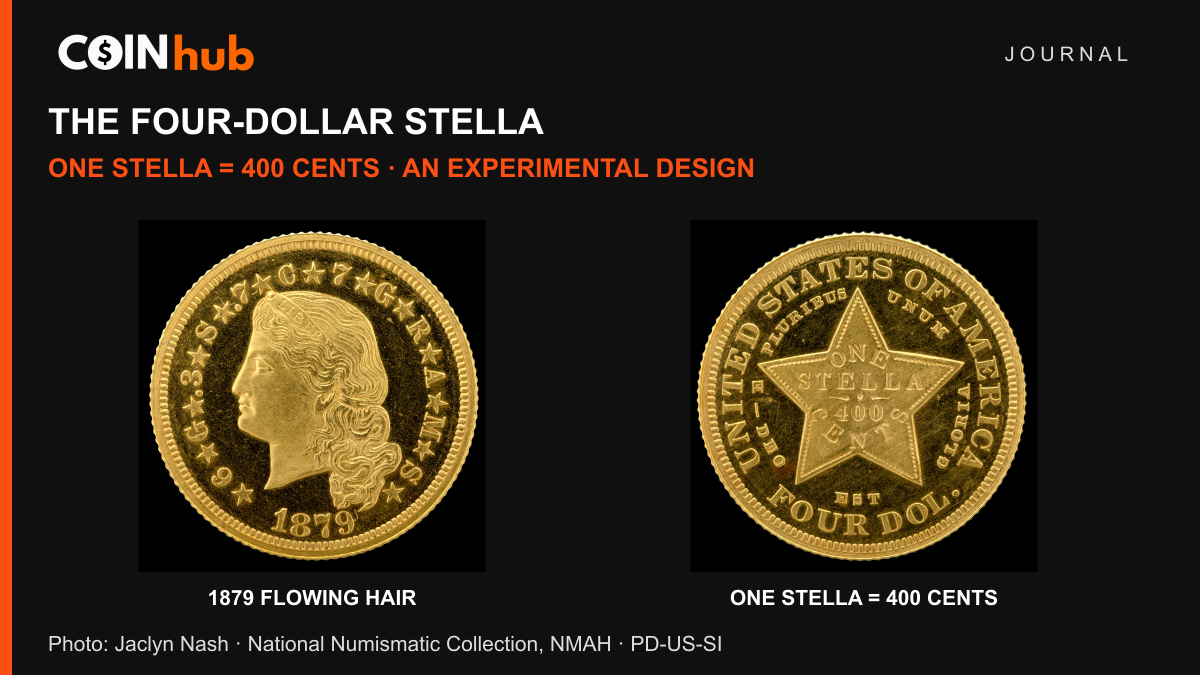
One Stella meant a proposed four-dollar coin
A four-dollar Stella is an experimental U.S. pattern coin dated 1879 or 1880. A pattern is a trial design made to study a possible coin. The Stella was proposed for trade with other nations. It never became a regular U.S. coin for daily use.
The reverse makes the proposed value unusually clear. ONE STELLA, 400 CENTS and FOUR DOL. all describe the same four-dollar unit. They are not three values to add together. The large five-pointed star helps explain the name: stella is Latin for star.
Read the real reference coin from the outside inward
The photograph shows an 1879 Flowing Hair Stella from the National Numismatic Collection. Start at the bottom of its reverse, or back. FOUR DOL. sits along the outer border. Move into the star to find ONE STELLA, then 400 CENTS below it.
That gives you a simple check: 400 cents equals four dollars. It is the face value in the plan, not the coin's worth to collectors today. A dealer's asking price or a major auction result answers a different question.
| Where to look | What the inscription tells you |
|---|---|
| FOUR DOL. near the lower reverse rim | The U.S. dollar value in the plan. |
| ONE STELLA inside the star | The name of that same unit. |
| 400 CENTS within the star | The same face value expressed in cents. |
| 1879 below Liberty's portrait | The date on this design; it does not by itself prove when this specimen was struck. |
On the obverse, or front, Liberty faces left with her hair falling behind her neck. The string of letters and numbers around her looks more like a formula than a usual coin legend. It was part of the plan for use abroad. Read it as a separate clue.
Why an international proposal had a four-dollar value
PCGS's Stella history connects the plan with John A. Kasson, the U.S. minister to Austria. The aim was to make a gold coin suited to exchange with money used in Europe. It was a bid to bridge systems of money, not a change that reached daily American use.
That distinction matters when sorting old U.S. gold coins. A Stella can be a genuine Mint-made pattern without having been a coin handed out in change. Its trial status does not make it a modern fantasy. Its four-dollar legend does not mean the Mint made four-dollar coins for daily use.
For more on trial designs versus coins made for daily use, see our guide to pattern coins and Judd numbers. A catalog number helps name a specific pattern. It does not make every object with a similar design genuine.
The metal formula is not an assay of your coin
Follow the small inscription around Liberty. The letters G, S and C refer to gold, silver and copper. The proposed formula is six grams of gold, 0.3 gram of silver and 0.7 gram of copper, totaling seven grams. Stars separate parts of the inscription.
The plan and the metal in a given coin are separate facts. Stack's Bowers' Flowing Hair Stella account makes that point. The formula suggests one alloy, or mix of metals. The source describes gold patterns made with the standard mix of 90% gold and 10% copper. The words on the coin are not a test of its metal.
Do not work out a coin's gold content from those letters alone. First find out which pattern and metal you have. A plated copy, a trial in another metal or an unclear piece needs its own review. A legend that looks right cannot replace that work.
Flowing Hair and Coiled Hair are two designs
Collectors distinguish Flowing Hair and Coiled Hair Stellas in both 1879 and 1880 dates. The usual attributions name Charles E. Barber for Flowing Hair and George T. Morgan for Coiled Hair. Stack's Bowers qualifies those names as traditional attributions, rather than presenting them as proven by surviving original design records.
The pictured coin is Flowing Hair. It is not an example of both styles. For a primary museum comparison, the Smithsonian's separate 1879 Coiled Hair Stella record shows Liberty's hair arranged in a coil. That object is a different coin from the Flowing Hair photograph used here.
The date needs care too. The Flowing Hair history includes pieces dated 1879 that were struck in 1880. Exact totals and the split between early pieces and later strikes are still unclear. A date gives you a starting point. It does not tell you the full story of when a piece was made or how many still exist.
Build an identification record before a value claim
Start with full photos of both faces. Record the date, hair design and each value shown on the coin. Then match the piece to a sound catalog entry. Note the claimed metal and check any grading record. Leave unclear details open instead of filling them with a sale listing's claims.
A price comparison comes after that identification. It needs the same date, design, metal, condition and sale context. A record for a different Stella does not establish the value of the object in front of you. This guide explains how to read the design; it does not offer a current appraisal.
Sources and photograph checked October 27, 2026. Photograph by Jaclyn Nash, National Numismatic Collection, National Museum of American History; source JN2015-6860-61, via the exact licensed file record. Public-domain photograph under PD-US-SI. Both faces are proportionally framed with no change to coin details or color.
