
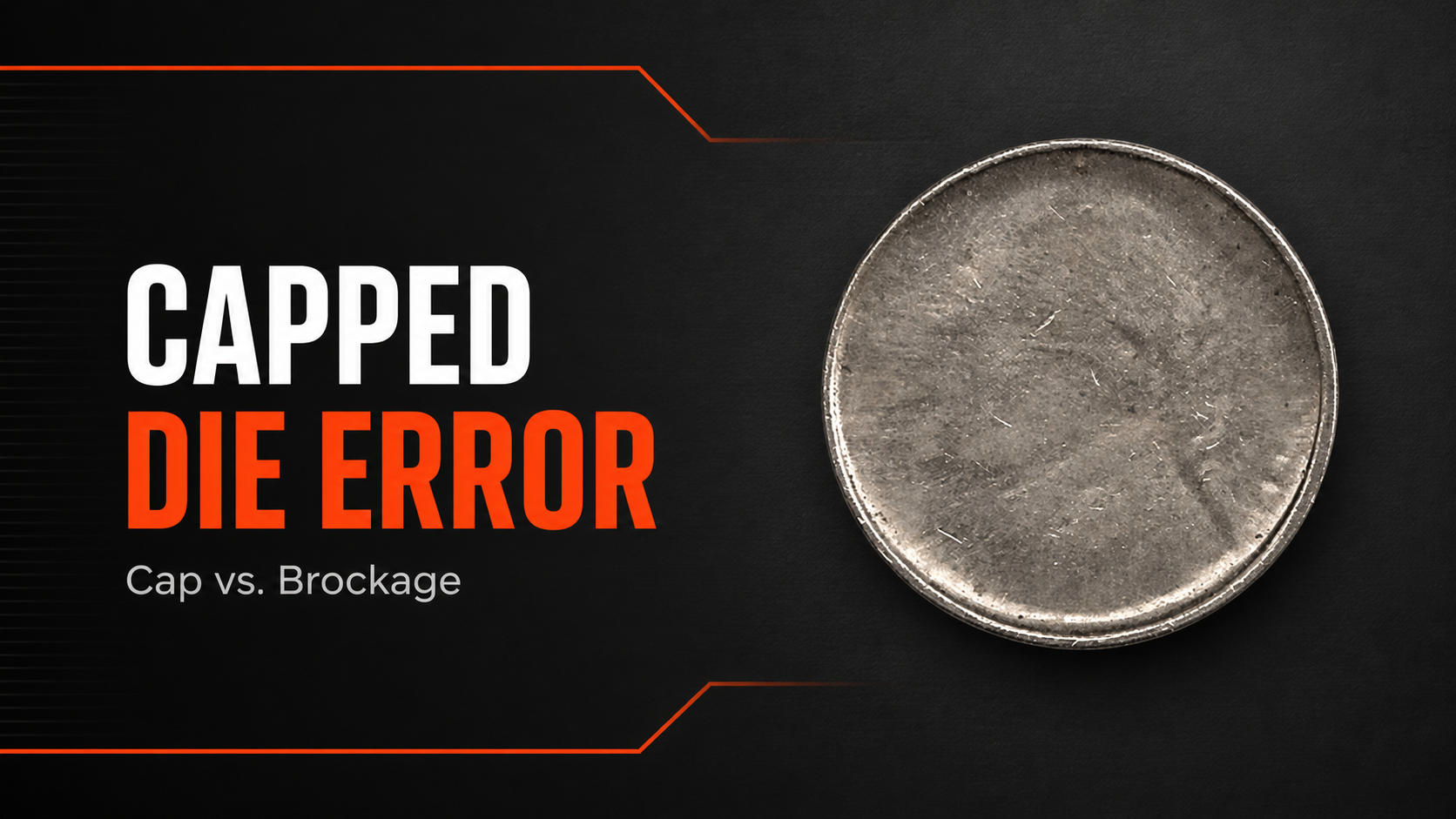
How a die cap forms
A normal struck coin is meant to leave the press after it is made. A die cap begins when one does not: it adheres to a die. NGC explains that the reverse of the adhered coin effectively acts as the new striking surface for the next blank. As striking continues, metal in the stuck coin can be pushed upward around the die shaft, producing the familiar cap-like profile.
That sequence matters because it gives a real cap two kinds of evidence: an original coin design that has been distorted by later strikes, and a shape consistent with being pressed around a die. It is not simply a coin that has been bent, crushed, or hollowed after leaving the Mint.
Die cap vs. brockage: the useful distinction
Collectors sometimes use the terms together because the same accident can make both. The die cap is the coin stuck to the die. The brockage is a later coin struck against that stuck coin. PCGS describes a brockage as an incuse mirror image created when a coin gets stuck to a die and strikes the next planchet.
What a genuine example can look like
- Early-stage cap: more of the original design may remain visible before repeated strikes reshape the coin.
- Later-stage cap: the coin may have a deep, hollow profile and tall walls formed around the die.
- Brockage from a cap: the affected face can show a sunken, reversed image rather than an ordinary raised design.
- Counterbrockage: NGC uses this term for a more complex chain involving a cap and a previously struck coin; it is not a label to apply from one unusual-looking photograph.
What it is not
Damage can make a coin look cupped, thin, or misshapen. A squeeze, heat damage, corrosion, a coin-operated-machine mishap, or a novelty alteration does not become a capped die error because it resembles one. PCGS states that it does not certify error coins that appear human-made rather than Mint-made.
Also keep a cap separate from other genuine errors. A broadstrike is normally wider because the collar failed to contain the coin. An off-center strike has part of its planchet unstruck because placement was wrong. Those errors can be dramatic, but their diagnostics are different.
A careful inspection checklist
- Photograph both faces and the edge. Include straight-on and side views so the profile is visible.
- Look for a coherent cause. A cap should show a plausible relationship between its distorted design and its cup-like form.
- Check for post-Mint damage. Scrape marks, unnatural seams, tool marks, or a shape that does not follow the coin’s design are warning signs.
- Compare concepts, not marketplace photos. Use the NGC and PCGS explanations to understand the process; do not assume every online label is accurate.
- Seek an attribution for a meaningful purchase. Professional authentication is the safer way to separate a Mint error from damage or alteration.
Why a mated relationship is interesting—but uncommon
A cap can create brockages, so a cap and one of its related brockage coins can be a mated relationship. NGC notes that such pairs are scarce. That does not mean unrelated odd coins should be paired based on similar dates or color. A credible mated claim needs matching physical evidence and expert examination.
Frequently asked questions
Is a capped die the same as a brockage?
No. The cap is the coin stuck to the die. A brockage is a later coin struck against that stuck coin and usually carries an incuse, mirror-image impression.
Can a damaged coin look like a die cap?
Yes. Post-Mint damage can make a coin look hollow or distorted. That is why shape alone is not enough to establish a Mint error.
Are capped die errors valuable?
They can attract collector interest, but there is no single value. Authentication, denomination, error stage, condition, and actual completed sales matter more than a generic “rare” label.
Should I submit a suspected cap for certification?
For a coin being sold or insured at a meaningful premium, a recognized error-attribution service is the prudent next step.
Source and image note: Error-process details were checked August 25, 2026 against NGC’s mint-error guide and PCGS’s error/variety explainer. The hero is a real die-cap photograph by Economicrealist, used under CC BY-SA 4.0 with attribution; CoinHub added only editorial framing and text. It is not a rendered or simulated coin.