
2026 Steve Jobs Dollar Coin: Design, Release, Value, and What to Check
The 2026 Steve Jobs dollar is a real U.S. Mint American Innovation $1 coin for California. It is not a quarter and it is not silver. A loose coin is still a $1 coin, but sealed Mint rolls and bags, high-grade certified examples, and strong early demand can give the issue collector premiums above face value.
What is the 2026 Steve Jobs dollar?
The 2026 Steve Jobs dollar is the California release in the U.S. Mint's American Innovation $1 Coin Program. The series honors inventions, innovators, and ideas connected to each state, territory, and the District of Columbia. California's 2026 coin honors Steve Jobs, the Apple co-founder whose influence reached far beyond computers into design, music, phones, publishing, entertainment, retail, and the way people interact with technology every day.
This is why the coin has attracted attention beyond normal dollar-coin collectors. Jobs is a modern cultural figure, not a traditional historical portrait subject. That makes the coin interesting to numismatists, Apple fans, technology collectors, and people who simply like the idea of a U.S. coin honoring American innovation from the modern era.
The coin is also easy to confuse with other denominations because many headlines shorten it to "Steve Jobs coin." It is not a U.S. quarter, half dollar, or silver dollar. It is a golden-colored $1 coin in the American Innovation series, with the normal Statue of Liberty obverse used on the program.
What does the Steve Jobs coin design show?
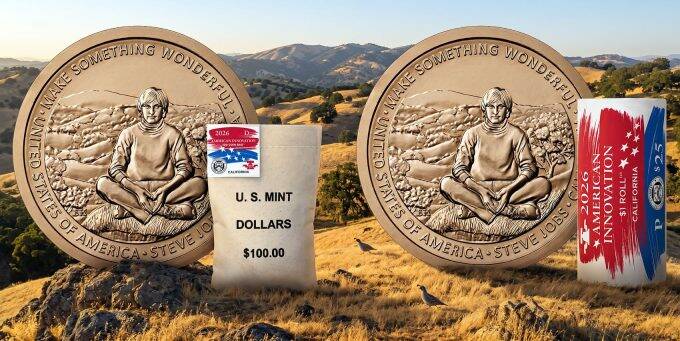
The reverse shows a young Steve Jobs seated in a northern California landscape of rolling hills and oak trees. The design is quieter than many people expected. Instead of showing an Apple logo, a computer, or a dramatic corporate image, it presents Jobs in a reflective pose. The design includes STEVE JOBS and part of the phrase MAKE SOMETHING WONDERFUL, a phrase closely associated with how Jobs is remembered by Apple and technology fans.
That design choice is important. Jobs is being honored less as a celebrity and more as a symbol of creativity, focus, and product vision. California's landscape also matters because so much of the personal-computer and consumer-technology story grew out of that region. For a coin series about innovation, the image connects place, person, and idea in a simple way.
The obverse, used across the American Innovation dollar program, shows the Statue of Liberty with IN GOD WE TRUST and $1. For 2026, the coin also carries a special Liberty Bell 250 privy mark to recognize America's Semiquincentennial year. That extra feature makes the 2026 releases stand apart visually from earlier Innovation dollars.
Where is the mint mark on the Steve Jobs dollar?
The mint mark is on the edge, not on the front or back of the coin. American Innovation dollars carry the date, mint mark, and E PLURIBUS UNUM on the edge lettering. A P means Philadelphia. A D means Denver. This matters because new collectors often look all over the design and think the mint mark is missing.
Edge lettering also creates one of the more interesting areas to inspect. On modern dollar coins, collectors sometimes look for unusual edge-lettering errors, such as missing edge lettering or doubled lettering. Those are not guaranteed, and most odd-looking coins are not valuable errors, but the edge is still the first place to check if you are trying to understand exactly what you have.
Release formats and U.S. Mint pricing
The U.S. Mint launched California Steve Jobs Innovation dollars on May 12, 2026. The products were sold as circulating-quality coins in rolls and bags, separated by mint facility. At launch, 25-coin rolls were priced at $61.00 and 100-coin bags were priced at $154.50. Those prices are above face value because they are numismatic products sold directly by the Mint, not rolls handed out at a bank teller window.
| Product | Mint | Launch price | Collector note |
|---|---|---|---|
| 25-coin roll | Philadelphia | $61.00 | Sealed rolls can appeal to collectors who want untouched original Mint packaging. |
| 25-coin roll | Denver | $61.00 | Denver rolls are usually collected alongside Philadelphia rolls as a pair. |
| 100-coin bag | Philadelphia or Denver | $154.50 | Bags are useful for bulk searching but may contain more contact marks from coin-to-coin contact. |
How strong was early demand?
Early demand was unusually strong for an American Innovation dollar. CoinNews reported that California Steve Jobs rolls and bags became unavailable soon after launch and reached about 1.17 million coins in the Mint's weekly sales reporting. That does not mean every loose Steve Jobs dollar is rare. It does mean the issue had real early interest, especially compared with many modern dollar coins that stay more quietly inside the collector community.
Why did that happen? The subject almost certainly helped. Jobs is instantly recognizable to a much wider audience than many traditional commemorative subjects. The 2026 Liberty Bell 250 privy mark also adds a one-year design feature, and the American Innovation series has been building a collector base over time. When a popular subject, a special year, and limited Mint product availability meet, buyers tend to move quickly.
How much is the 2026 Steve Jobs dollar worth?
At the most basic level, it is a $1 coin. The metal is not silver or gold, so there is no bullion floor like there would be with a silver commemorative. The collector value comes from demand, condition, original packaging, grade, and whether buyers are still chasing the issue after the initial launch rush.
A loose circulated or handled example should not automatically be treated as rare. If these coins enter circulation or are removed from rolls, many will simply trade as novelty dollar coins or small-premium collectibles. Sealed Mint rolls and bags are a different category because buyers can still see the original product format and may value the packaging as part of the collectible.
Certified examples can carry the biggest premiums, but only at the right grades. Modern coins are expected to be clean, so lower certified grades may not make economic sense after grading fees. High-end coins, especially strong MS67, MS68, MS69, or better if available, are where registry buyers and label collectors may pay more. Early-release labels, first-day labels, and special holders can also affect price, although those premiums vary with demand.
| Example | Value driver | What to watch |
|---|---|---|
| Loose coin | Face value plus collector interest | Do not overpay just because the subject is famous. |
| Sealed roll | Original Mint packaging and demand | Check whether it is Philadelphia or Denver and whether the wrapper is intact. |
| 100-coin bag | Bulk original Mint product | Bags can be searched, but coins may show contact marks. |
| Certified high grade | Grade, label, population, and timing | Use recent sold listings, not only asking prices. |
What should collectors check?
Is the Steve Jobs dollar a good coin to collect?
For a modern U.S. coin, it has a strong story. The American Innovation program can be overlooked because the coins do not circulate widely in everyday change, but the Steve Jobs issue gives the series a subject with broad public appeal. It also captures a moment when U.S. coins are stretching beyond presidents, buildings, and classical figures to recognize modern creativity.
As an investment, the answer is more cautious. Popular modern coins can spike early and settle later. The safest way to approach the issue is to collect the format you actually like: one nice raw example, a P and D roll pair, a sealed bag, or a certified high-grade piece. Let the coin's subject and design matter first, then let price discipline guide the rest.
CoinHub bottom line
The 2026 Steve Jobs dollar is interesting because it reaches outside the normal coin-collector lane. It connects California, technology, design culture, and a major U.S. Mint series. A loose coin is not automatically a jackpot, but the issue is absolutely worth watching in sealed Mint packaging and high certified grades. If you are buying one, buy the coin with clear eyes: famous subject, real collector demand, but still a modern $1 coin whose value depends on condition and market interest.
CoinHub tip: The best first check is the edge. Confirm the date, mint mark, and lettering before deciding what you have. From there, compare the coin or sealed product to recent sold listings instead of relying on launch hype alone.
Sources checked: U.S. Mint California Innovation dollar release, CoinNews launch report, and CoinNews sales update.