
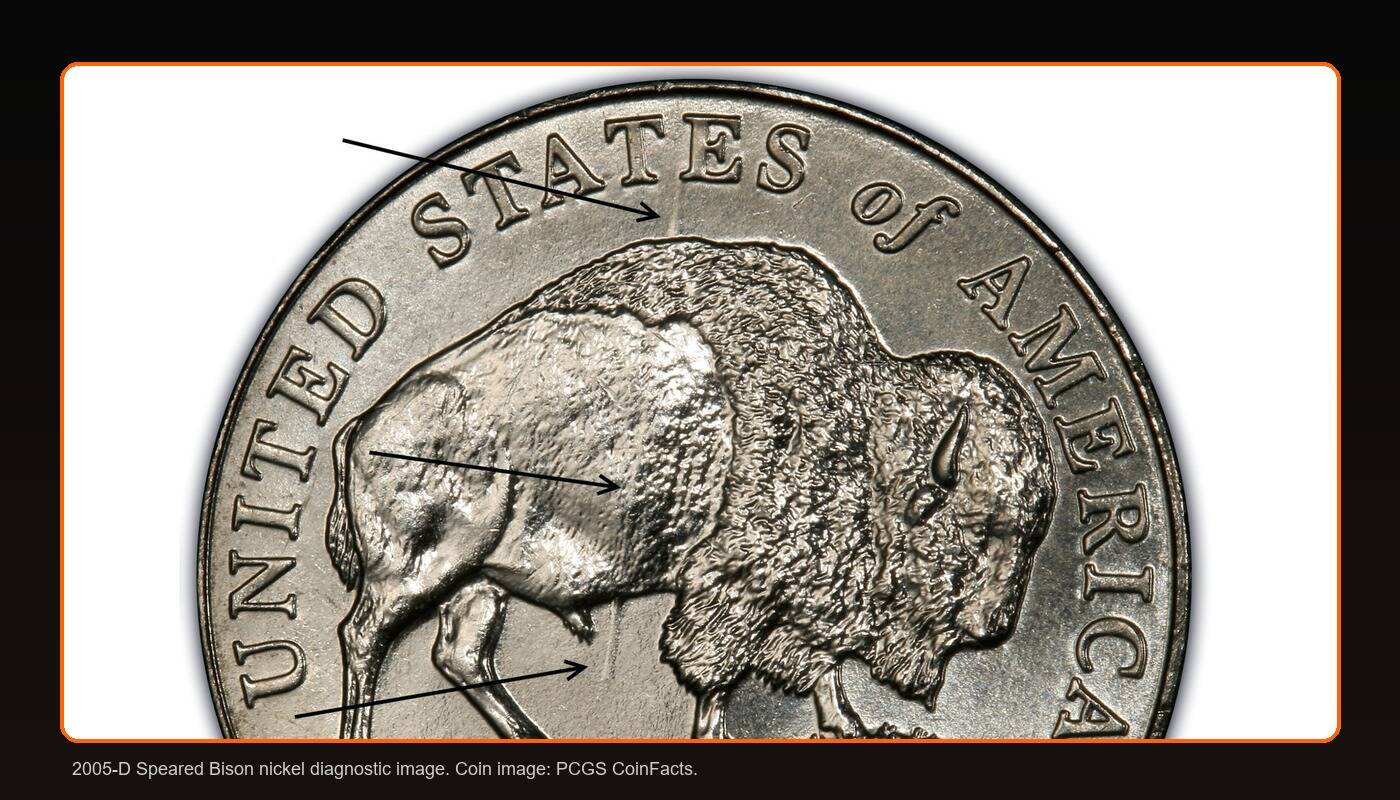
What Is The 2005-D Speared Bison Nickel?
The Speared Bison is a collectible variety from the 2005 Westward Journey Jefferson nickel series. The reverse design shows an American bison, and the error nickname comes from a die gouge that transferred to struck coins as raised metal. Collectors usually describe it as a diagonal "spear" across the bison. The important word is raised. If the line is cut into the coin, dark, jagged, or obviously caused after the coin left the Mint, it is probably damage instead of the recognized variety.
PCGS lists the coin as the 2005-D 5C Speared Bison, PCGS #84159, with a Denver mintage base of 487,680,000 pieces. PCGS also gives the basic coin specifications: plain edge, 21.20 millimeter diameter, 5.00 gram weight, and a 75% copper, 25% nickel composition. The U.S. Mint's nickel reference confirms the American Bison reverse as part of the 2005 Westward Journey nickel designs, which helps separate this issue from the older Buffalo nickel series.
How To Identify The Real FS-801 Variety
Start with the date and mint mark. The Speared Bison variety collectors search for is a 2005-D nickel. The obverse has Jefferson facing right, the date 2005, and the D mint mark. Then flip the coin to the reverse and look at the bison under a bright light with magnification. The known diagnostic appears on the bison side, not on Jefferson's portrait.
- Look for raised metal. A genuine die-gouge line should sit above the coin surface because the gouge was in the die.
- Check the location. The line should match the known diagonal path across the bison's body, not just any random mark on the field.
- Compare both sides. The obverse can have ordinary contact marks, but the variety attribution depends on the reverse diagnostic.
- Do not clean it. Cleaning can make photos look worse, reduce value, and make authentication harder.
The most common false alarm is a scratch. A scratch usually looks incuse, meaning it cuts down into the metal. It may have displaced rims, dark toning inside the line, or an uneven path that does not match the recognized die gouge. Many circulated 2005 nickels have hits and scrapes. A damaged coin can look dramatic in a phone photo while still being only a normal nickel.
What Is A 2005-D Speared Bison Worth?
Value depends on grade, attribution, eye appeal, and current demand. PCGS CoinFacts showed an auction record of $2,650 for an MS66 example, but that is a record-level certified coin, not a promise for every nickel with a line on it. The same PCGS data also shows more moderate guide levels in lower Mint State grades. In other words, the variety can matter, but condition still matters a lot.
As a practical collector range, a raw circulated coin with a suspicious line should be treated carefully until it is confirmed. A certified Speared Bison in a lower Mint State grade may trade in the low hundreds, while sharper certified examples can bring more. Market prices move, and auction records can be thin for modern varieties, so check recent PCGS, NGC, Heritage, GreatCollections, or other reputable auction data before making a selling or grading decision.
Why Authentication Matters
The Speared Bison has enough value potential that sellers sometimes label ordinary scratches as the variety. That is exactly why authentication and attribution matter. PCGS, NGC, ANACS, and other recognized services can attribute major varieties when the coin matches the known diagnostic. For a low-grade or heavily damaged coin, the grading fee may not make sense. For a sharp uncirculated candidate with a clean raised gouge, certification can help buyers trust what they are looking at.
Good photos help before you spend money. Take one clear full reverse photo, one close-up of the bison body where the line appears, and one obverse photo showing the date and D mint mark. Use neutral lighting, avoid harsh filters, and keep the coin in a holder so it is not rubbed or dropped during the process.
Do Not Confuse It With Other Bison Nickels
The 2005 Bison nickel is sometimes casually called a "buffalo nickel," but it is not the classic 1913-1938 Buffalo nickel. It is a modern Jefferson nickel with a one-year reverse design. Also, the Speared Bison is not a missing-leg nickel, detached-leg claim, doubled die claim, or general "rare 2005 nickel" claim. The recognized search target here is the 2005-D Speared Bison FS-801 die-gouge variety.
That distinction keeps the hunt honest. A normal 2005-D Bison nickel can be fun to save, but most are not rare. The premium comes from matching the known raised die-gouge diagnostic and, ideally, having that attribution on a trusted grading label.