
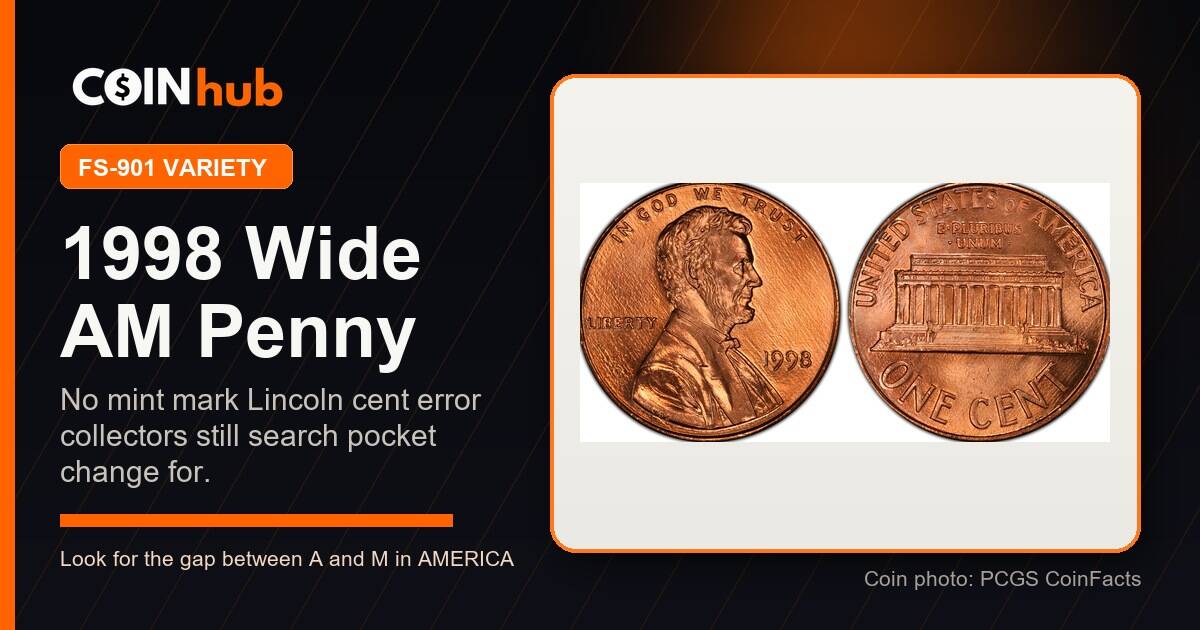
1998 Wide AM FS-901 Identification Guide
What Makes The 1998 Wide AM Penny Different?
The 1998 Wide AM penny is not valuable because of the date alone. It is valuable because some Philadelphia business-strike Lincoln cents were struck with a reverse style that looks like the proof reverse. On that reverse, the A and M in AMERICA are separated instead of nearly touching.
PCGS lists the coin as the 1998 1C Wide AM FS-901, with a Philadelphia mintage of 5,032,155,000 regular cents for the year. That huge mintage is why most 1998 cents are only ordinary pocket-change coins. The premium comes from finding the correct FS-901 reverse variety.
How To Identify The Real FS-901 Variety
Flip the coin over and look at AMERICA. On the Wide AM variety, the A and M should show a noticeable open space. On a normal close AM reverse, those two letters sit much closer together.
- Check the reverse, not the front of the coin.
- Look at the spacing between the A and M in AMERICA.
- Confirm the coin is a 1998 Philadelphia cent with no mint mark.
- Compare it with certified PCGS or NGC examples before paying a premium.
This is a small design-variety detail, so lighting and angle matter. Use a clear close-up photo or a loupe, and compare the spacing to a normal 1998 penny if you have one nearby.
What Is A 1998 Wide AM Penny Worth?
Value depends heavily on condition, color, eye appeal, and whether the coin has been professionally attributed. Raw circulated examples can be modest, while certified Red Mint State coins can sell for more because buyers know the variety and grade are confirmed.
PCGS CoinFacts lists an auction record of $940 for a 1998 Wide AM FS-901 in MS67 Red, sold through Heritage Auctions on June 4, 2014. PCGS Auction Prices also shows an MS66 Red example selling for $89 in a September 2019 Heritage internet auction. Those records show the main point: grade matters, and the biggest prices usually go to the cleanest certified coins.
Common Mistakes To Avoid
The biggest mistake is assuming every 1998 penny is the error. Most 1998 Lincoln cents are regular Close AM coins. You need the reverse spacing to be right, not just the correct year.
Another mistake is confusing the 1998 Wide AM with the better-known 1999 or 2000 Wide AM cents. They are related varieties, but collectors price them separately. Damage, plating bubbles, lighting glare, and blurry photos can also make the spacing harder to judge.
Should You Grade A 1998 Wide AM Penny?
Grading makes the most sense when the coin has clear Wide AM diagnostics and strong condition. A bright Red Mint State coin with clean fields has a better case for PCGS or NGC submission than a worn, stained, or damaged example. If the coin is circulated but clearly the variety, it can still be worth saving, but grading fees should be weighed against the likely sale price.
Sources used: PCGS CoinFacts, PCGS Auction Prices, and Lincoln Cent Resource. Market prices can change, so use current auction records and professional attribution when buying, selling, or grading.