
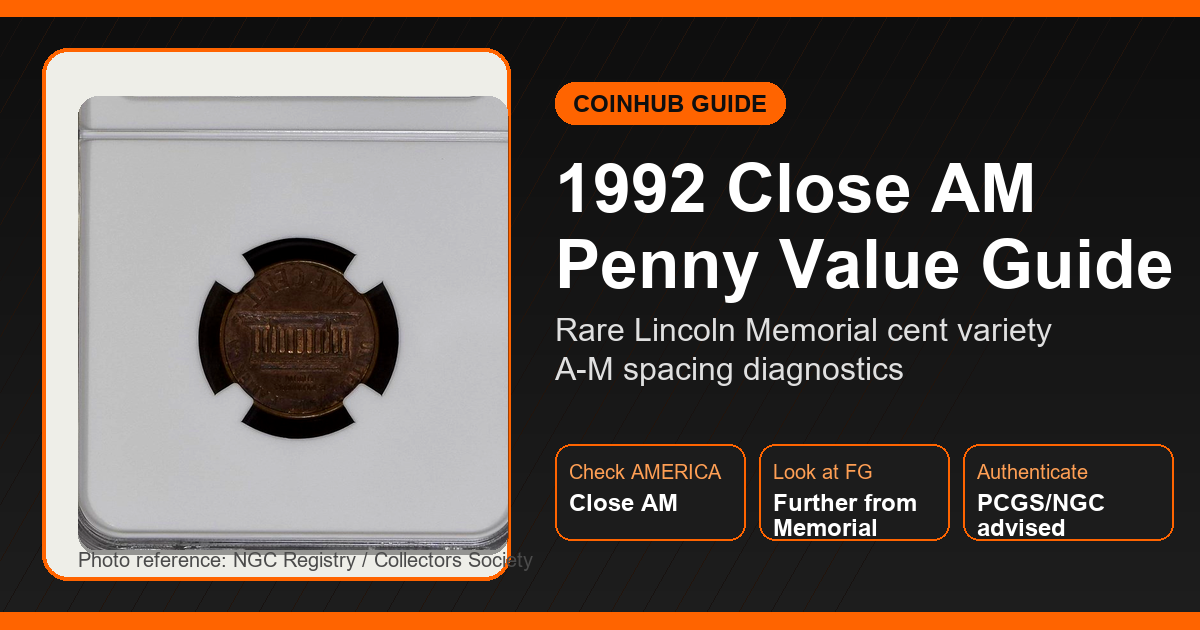
How to Spot the Rare 1992 Close AM Lincoln Cent
Why the 1992 Close AM Penny Matters
The 1992 Close AM Lincoln cent is one of the strongest modern penny varieties because it hides in plain sight. It is not a dramatic doubled die, missing design, or off-center strike. It is a reverse-design variety that most people would overlook unless they know exactly where to look.
For most Lincoln Memorial cents dated 1959 through 1992, the letters A and M in AMERICA on the reverse are separated by a visible gap. That is the normal Wide AM style for those years. Starting with 1993 circulation cents, the Mint used a reverse with the A and M placed very close together. A small number of 1992 and 1992-D cents appear to have been struck with that newer-style reverse early, creating the rare Close AM variety.
That little spacing detail can be worth far more than one cent. The challenge is that millions of normal 1992 pennies still exist, and online listings often misuse the term. The coin must have the correct reverse diagnostics, not just a blurry photo or a seller's claim.
How to Check the AMERICA Spacing
Turn the coin over to the Lincoln Memorial side and look at the word AMERICA. On a normal 1992 cent, there should be a clear gap between the bottom of the A and the left leg of the M. On a Close AM, those letters are very close together and can appear almost touching.
A magnifier helps, but the best tool is comparison. Put a normal 1992 cent beside a 1993 cent, or compare your coin to certified images from PCGS or NGC. The 1993 reverse shows the Close AM look that accidentally appeared on the rare 1992 business strikes.
- 1992 Wide AM: common business-strike reverse, with a visible A-M gap.
- 1992 Close AM: rare business-strike reverse, with the A and M very close.
- 1993 Close AM: normal for 1993 cents, useful for comparison but not rare by itself.
The FG Initials Are the Second Diagnostic
Do not stop at the AM spacing. The designer initials FG, for reverse designer Frank Gasparro, are another important clue. On the Close AM reverse, the FG initials are positioned farther away from the base of the Lincoln Memorial. On the normal Wide AM reverse, the initials sit closer to the building.
This matters because photos can be misleading. A worn coin, glare, dirt, or a poor camera angle can make the A and M look closer than they are. The FG position gives collectors a second check before spending money on grading.
1992 Close AM Penny Value
Values depend heavily on whether the coin is Philadelphia or Denver, whether it is brown, red-brown, or full red, and whether it has been certified by PCGS, NGC, or another respected grading service. A normal circulated 1992 penny is usually only worth one cent, but an authenticated Close AM can become a major modern variety.
| Coin | Typical Collector Takeaway |
|---|---|
| Common 1992 or 1992-D Wide AM | Usually face value if circulated; modest premium only in exceptional uncirculated condition. |
| Suspected raw Close AM | Needs careful attribution. Do not clean it, and avoid selling it cheaply until it is verified. |
| Certified 1992-D Close AM | Often a four-figure variety when authenticated, with stronger prices for red Mint State examples. |
| Certified Philadelphia 1992 Close AM | Generally considered even rarer than the Denver version and can bring five figures in top grades. |
PCGS lists a $25,850 auction record for a Philadelphia 1992 Close AM in MS67RD and a $14,100 record for a 1992-D Close AM in MS65. Those are record-level certified coins, not a guarantee for every example. Still, they show why this variety gets so much attention from Lincoln cent hunters.
Philadelphia vs. Denver: Which One Is Rarer?
Both versions are scarce compared with the huge mintages of ordinary 1992 cents. PCGS lists the Philadelphia mintage at more than 4.6 billion and the Denver mintage at more than 4.4 billion. Against numbers that large, even a few dozen or a few hundred confirmed Close AM pieces is an extremely small survival pool.
Older references often described the Philadelphia Close AM as almost impossibly rare, with only a tiny number reported. More examples have surfaced over time, especially for the Denver issue, but both remain serious finds. The safest way to think about it is simple: a normal 1992 cent is common; a correctly attributed 1992 Close AM is not.
Common Mistakes to Avoid
The most common mistake is assuming every close-looking 1992 reverse is the rare variety. The AM area must be checked sharply, and the FG initials should match the Close AM reverse. Another mistake is confusing the 1992 Close AM with later Wide AM varieties from 1998, 1999, and 2000. Those are different years and a different collecting angle.
Also be careful with damaged coins. Corrosion, staining, flattening, and heavy wear can create shadows that make the spacing look wrong. If the coin appears promising, take clear photos of the full obverse, full reverse, close-up of AMERICA, and close-up of FG before asking for opinions or submitting it.
CoinHub tip: If you find a possible 1992 Close AM penny, place it in a non-PVC holder and handle it only by the edges. Because the value is tied to authentication, a real candidate is worth slowing down for. A certified label with the Close AM attribution is what separates a valuable modern variety from a hopeful pocket-change guess.
Research checked against PCGS CoinFacts, NGC Registry/Collectors Society, Lincoln Cent Resource, USA Coin Book, and current public auction-record references. Values can change with grade, color, certification, and collector demand.