
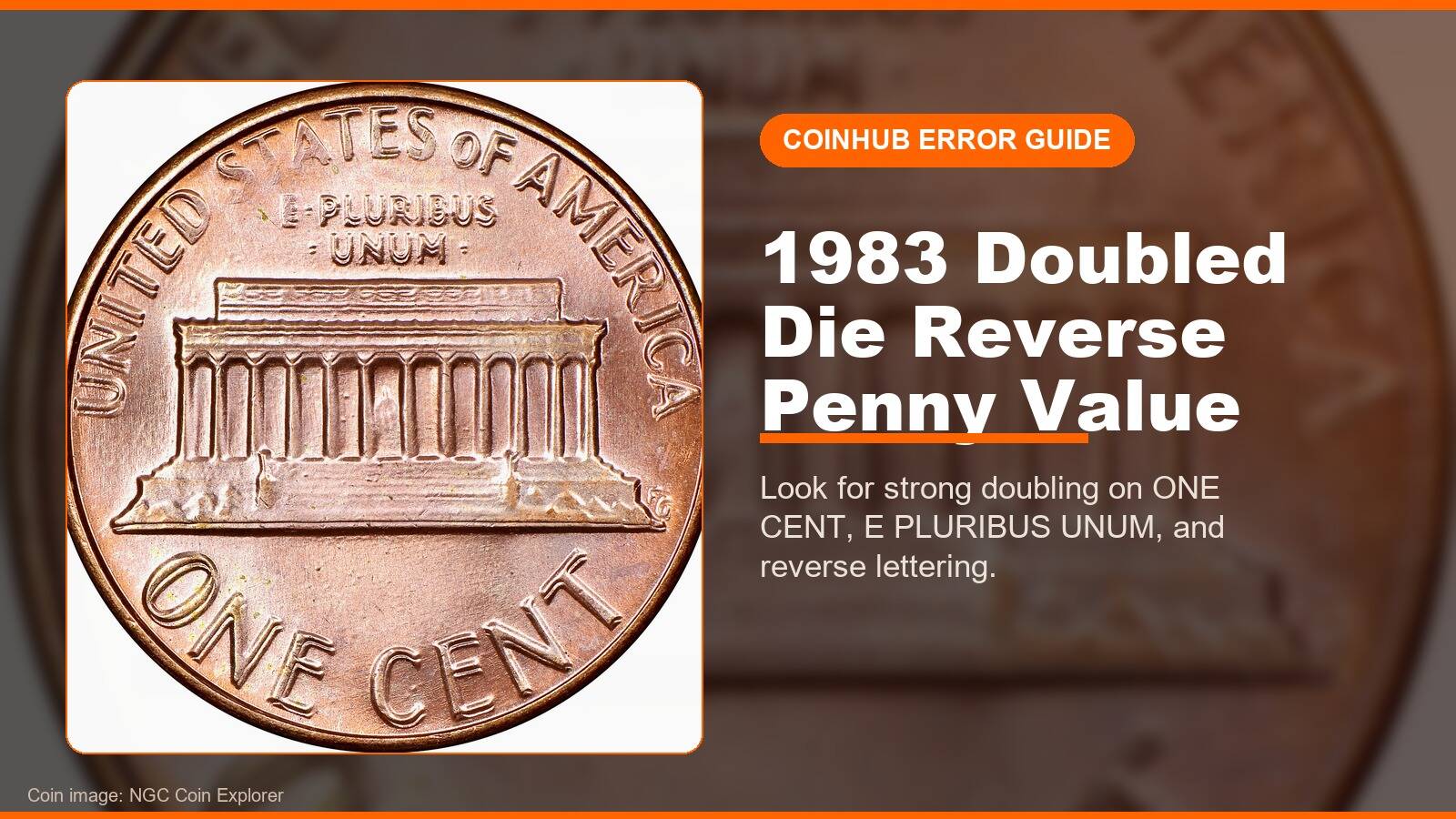
1983 Penny Error: FS-801 Doubled Die Reverse
What Is the 1983 Doubled Die Reverse Penny?
The 1983 doubled die reverse penny is not just a blurry strike or normal wear. It was struck by a die that already carried doubled design details, so the doubling repeats in a specific pattern on genuine examples.
Collectors usually call the major variety FS-801. It is one of the better-known Memorial reverse Lincoln cent doubled dies because the reverse lettering can be strong enough to spot with a loupe.
Where to Look for the Doubling
Flip the coin over. The strongest pickup points are usually on the reverse, not Lincoln's portrait side.
- Check ONE CENT for clear separation and extra thickness.
- Look at E PLURIBUS UNUM, especially the central letters.
- Check UNITED STATES OF AMERICA around the rim for doubled letter edges.
- Compare the pattern to certified PCGS or NGC examples before calling it real.
1983 Doubled Die Reverse Penny Value
Value depends heavily on condition, color, and professional attribution. Worn or damaged coins bring less, while clean Mint State red or red-brown coins can sell for much more.
NGC reported 2023 Heritage Auctions sales from $264 for an NGC MS 65 RD example to $2,640 for an NGC MS 68 RD example. PCGS CoinFacts lists a $2,760 auction record for an MS68RD example.
That does not mean every 1983 penny is valuable. A normal 1983 zinc cent is usually common. The premium is for the recognized doubled die reverse variety, especially when the coin is sharp, red, and certified.
Machine Doubling vs. a Real Doubled Die
This is the big trap. Machine doubling often looks flat, shelf-like, or smeared. A real doubled die usually has rounded, separated design details that match known diagnostics.
If the doubling only looks like a thin ledge along one side of the letters, slow down. Compare it to an attributed FS-801 example before spending money on grading.
Should You Get It Graded?
If the doubling is obvious and the coin has strong red color, sharp detail, and very few marks, certification can make sense. For lower-grade or questionable examples, get a second opinion first.
PCGS and NGC attribution matters because buyers want confidence that the coin is the true 1983 doubled die reverse, not mechanical doubling or a normal zinc cent.
Sources checked: PCGS CoinFacts, PCGS Auction Prices, and NGC Face Value: 1983 Cents. Values can change with grade, color, eye appeal, and market demand.