
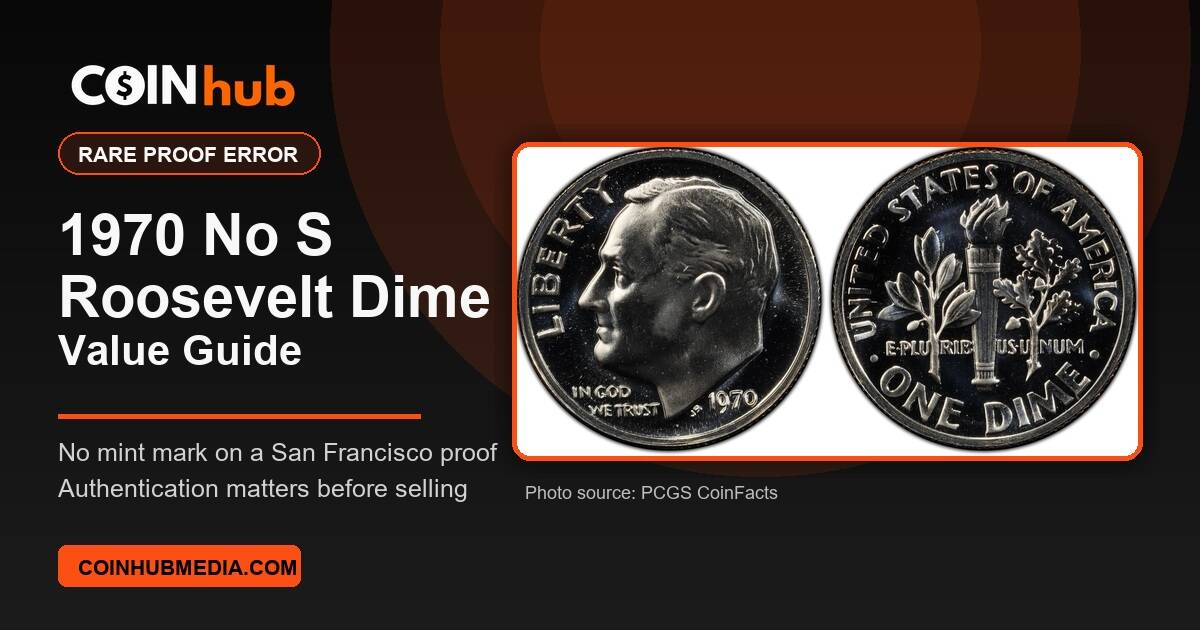
1970 No S Roosevelt Dime Value: Rare Proof Error Guide

Why The 1970 No S Dime Matters
The 1970 No S Roosevelt dime is one of the important proof-only missing mint mark errors in the Roosevelt dime series. PCGS notes that proof dimes were accidentally struck without S mint marks in 1968, 1970, and 1983. The 1970 issue is not as famous as the 1975 No S dime, but it is still a serious collectible variety that belongs on any short list of modern proof errors.
This is not the same thing as finding a normal 1970 dime without a mint mark in change. Regular Philadelphia dimes from 1970 do not have a mint mark, so the missing mint mark only matters on a proof coin that should have been struck for a San Francisco proof set.
How To Identify A Real 1970 No S Proof Dime
Start by checking whether the coin is actually a proof. A genuine 1970 No S dime should have sharp proof detail, mirrored fields, and the overall look of a proof-set coin. On the obverse, look near the date where the S mint mark would normally appear. On this variety, the area above the date should be blank.
If the coin looks like an ordinary circulated 1970 dime, it is probably not the valuable error. The most common mistake is confusing a normal Philadelphia dime with the proof-only San Francisco error.
How Rare Is The 1970 No S Dime?
PCGS lists a mintage figure of 2,200 for the 1970 No S proof dime and notes that the 1970 and 1983 No S proof dimes are similarly scarce, with roughly 500 or so examples known. That makes it much scarcer than a normal proof dime from the same year, but still findable enough that collectors continue to watch old proof sets carefully.
The best place to search is inside original 1970 proof sets, especially sets that have not been handled heavily. Loose coins can still be real, but proof surfaces are easy to damage, and certification becomes more important when the coin is outside the original government packaging.
How Much Is A 1970 No S Dime Worth?
Value depends on authentication, grade, cameo contrast, surface quality, and current demand. PCGS shows price guide levels beginning in the hundreds of dollars for lower proof grades, and the PCGS CoinFacts page lists an auction record of $1,610 for a PR69 example sold through Heritage Auctions in 2003.
Because proof quality matters so much, two genuine examples can sell for very different prices. A hazy or hairlined coin may trail the market, while a clean certified coin with strong contrast can bring more attention from registry and variety collectors.
What To Do If You Think You Found One
- Do not clean the coin or wipe the proof fields.
- Confirm it came from a proof set or has obvious proof surfaces.
- Compare the date area with photos from PCGS or NGC.
- Get a strong candidate authenticated by PCGS or NGC before selling.
Authentication is important because the difference between a common 1970 dime and a real 1970 No S proof dime is enormous. A clear photo of the whole obverse, plus a close photo of the date area, is usually the first step before sending it in.
Sources checked: PCGS CoinFacts for the 1970 10C No S proof Roosevelt dime, PCGS auction record and price guide details, and NGC Roosevelt dime reference pages.