
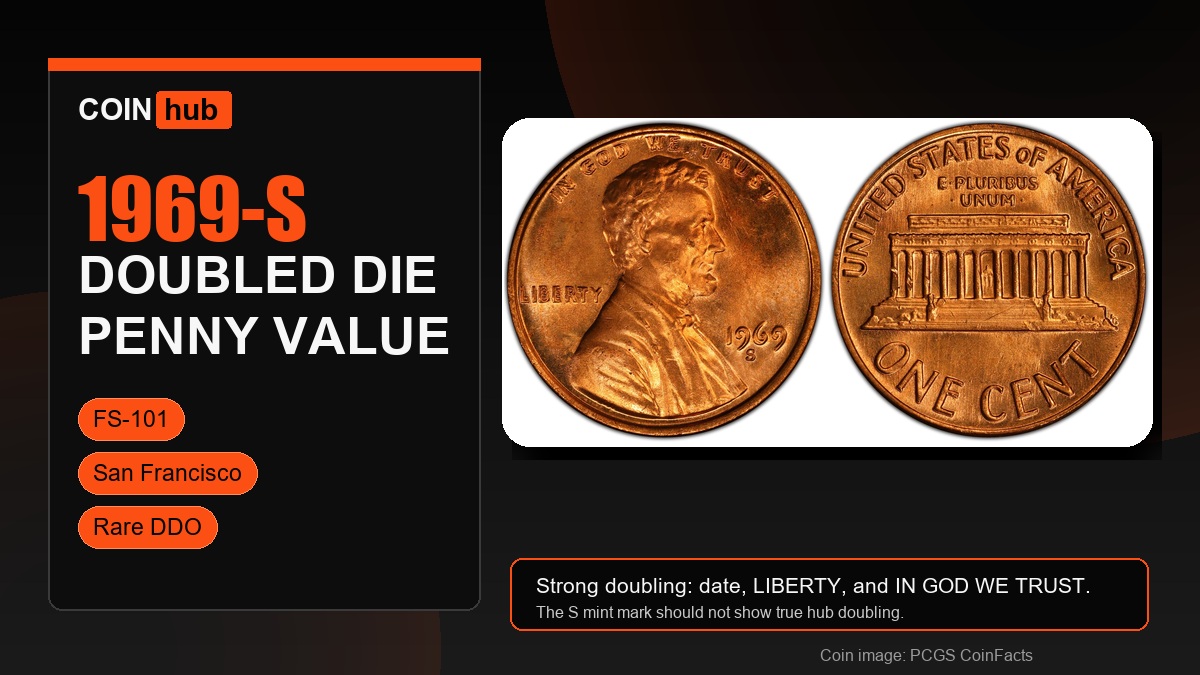
How To Spot The 1969-S Doubled Die Obverse Cent
Learn how to spot the rare 1969-S doubled die penny, what areas should show real doubling, why the S mint mark matters, and why authentication is essential before selling.
Why This Penny Is So Famous
The 1969-S doubled die penny belongs in the same conversation as the 1955 and 1972 doubled die Lincoln cents, but it is much harder to find. PCGS describes the variety as a dramatic doubled die obverse with a small surviving population, and major certified examples have brought strong auction prices.
Part of the legend is the backstory. Early examples were caught up in a counterfeiting investigation, and PCGS notes that some genuine coins were initially treated with suspicion before the variety was accepted as a real U.S. Mint error.
Where To Look For The Doubling
The strongest doubling should be on the front of the coin. Check these areas first:
- The date, especially the 1969 digits.
- The word LIBERTY on the left side.
- The motto IN GOD WE TRUST across the top.
On a true doubled die, the doubling has real separation and looks like a second raised design from the die itself. It should not look like flat shelf-like smearing.
The Mint Mark Warning
The S mint mark is one of the biggest clues. On a genuine 1969-S doubled die obverse cent, the mint mark should not show true hub doubling because the mint mark was punched into the die separately. If the S mint mark is doubled the same way as the letters and date, be careful. That often points toward machine doubling, which is common and usually not valuable.
How Much Is A 1969-S Doubled Die Penny Worth?
Value depends heavily on authentication, grade, color, surface quality, and demand at the time of sale. A genuine circulated example can still be a major coin, while certified Mint State red examples can reach very high prices. PCGS lists an auction record of $126,500 for an MS64 example, and other certified examples have sold for strong five-figure amounts.
Because the value gap between a real doubled die and ordinary machine doubling is enormous, this is not a coin to guess on from a blurry photo. Serious candidates should be reviewed by a knowledgeable dealer and submitted to PCGS or NGC for attribution.
Sources checked: PCGS CoinFacts pages for the 1969-S doubled die obverse Lincoln cent, PCGS auction records, and major auction reference listings.