
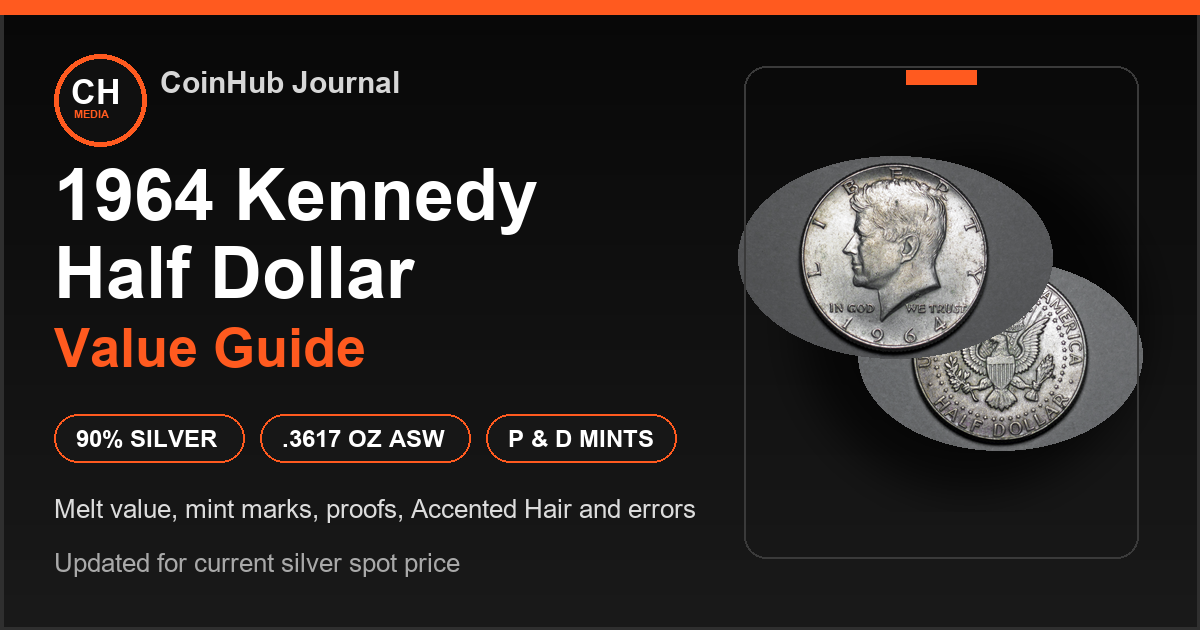
CoinHub Journal Value Guide
1964 Kennedy Half Dollar Silver Value, Mint Marks, Proofs, and Errors
Quick answer: the 1964 Kennedy half dollar is a 90% silver coin with about 0.3617 troy ounce of pure silver. With silver around $75.40 per ounce on May 30, 2026, the melt value is about $27.27 before any collector premium. Most circulated examples are valued from their silver content first, while high-grade coins, attractive proofs, Accented Hair proofs, and authenticated errors can be worth more.
Why the 1964 Kennedy half dollar matters
The Kennedy half dollar was introduced soon after President John F. Kennedy's assassination, and the first 1964 coins became one of the most widely saved modern U.S. coins. The obverse portrait was by Gilroy Roberts, while Frank Gasparro designed the reverse with the presidential seal eagle. For collectors, the 1964 date has a special place because it is the only regular Kennedy half dollar struck for circulation in 90% silver.
That mix of history, silver content, and public saving makes the coin easy to find in lower grades but still very collectible when the condition, proof quality, or variety is better than average.
How much is a 1964 Kennedy half dollar worth?
Start with silver melt, then add collector premium only when the coin earns it. A circulated 1964 half dollar with normal wear usually trades close to its silver value plus a modest retail premium. Bright uncirculated coins can bring more, especially if the surfaces are clean and the strike is strong. Certified high-grade examples can separate sharply from melt value because many saved coins have marks, haze, or handling.
| Type | What to expect | What to check |
|---|---|---|
| Circulated 1964 | Silver value usually drives the price. | Damage, cleaning, rim hits, and current silver spot. |
| Uncirculated 1964 or 1964-D | Premium depends on eye appeal and grade. | Luster, cheek marks, contact marks in the fields, and strike. |
| 1964 proof | Common as a proof, but nicer cameo coins are stronger. | Haze, hairlines, cameo contrast, and original packaging. |
| Accented Hair proof | The major 1964 proof variety collectors ask about. | Hair detail above Kennedy's ear and recognized variety diagnostics. |
| Major mint error | Can be worth much more than melt if genuine. | PCGS or NGC authentication before buying or selling as an error. |
Mint marks and mintages
Philadelphia coins have no mint mark. Denver coins show a small D mint mark on the reverse, near the eagle's left talon and the olive branch area. Both issues are common in circulated condition, but that does not make every coin equal. Clean, bright, well-struck pieces can still stand out from the typical saved example.
- 1964 Philadelphia circulation strike: about 273.3 million coins.
- 1964-D Denver circulation strike: about 156.2 million coins.
- 1964 proof Kennedy half dollar: about 3.95 million coins.
The 1964 Accented Hair proof
The Accented Hair proof is the variety many collectors hope to find in older proof sets. It is not a circulation strike; it is a proof variety. The name comes from stronger hair detail above Kennedy's ear, and specialists also look for lettering diagnostics to confirm the attribution. Because proof coins are easily affected by hairlines and haze, condition matters a lot.
If you think you have an Accented Hair proof, compare it with certified examples before calling it rare. A clean certified piece with strong eye appeal is a different market than a raw proof with haze or scratches.
Errors and varieties worth checking
Most 1964 Kennedy halves are normal silver coins, but it is still worth slowing down before tossing one into a bulk silver stack. Look for obvious doubled design elements, unusual planchet problems, dramatic clips, off-center strikes, and coins that appear to be struck on the wrong planchet. Serious error claims should be authenticated, because altered coins and damage can look convincing at first glance.
CoinHub tip: weigh the coin if something looks unusual. A normal 1964 Kennedy half dollar weighs 12.5 grams. Big differences in weight, color, edge appearance, or diameter are clues that the coin needs closer inspection.
Basic specifications
| Designer | Obverse by Gilroy Roberts; reverse by Frank Gasparro. |
|---|---|
| Weight | 12.5 grams. |
| Diameter | 30.6 mm. |
| Composition | 90% silver and 10% copper. |
| Actual silver weight | About 0.3617 troy ounce. |
Should you grade a 1964 Kennedy half dollar?
For ordinary circulated coins, grading usually does not make financial sense because the value is mostly silver. Consider professional grading when the coin is exceptionally clean, has strong proof cameo contrast, may be an Accented Hair proof, or appears to be a major mint error. Certification helps most when the coin is already a standout.
Bottom line: a 1964 Kennedy half dollar is never just pocket change. Even common examples carry meaningful silver value, and the best coins can become collectible because of grade, proof quality, variety, or confirmed error status.
Sources and image attribution: U.S. Mint Kennedy half dollar production history, PCGS CoinFacts, NGC U.S. half dollar price guide, and Wikimedia Commons 1964 Kennedy half dollar images used for the CoinHub guide graphic.