
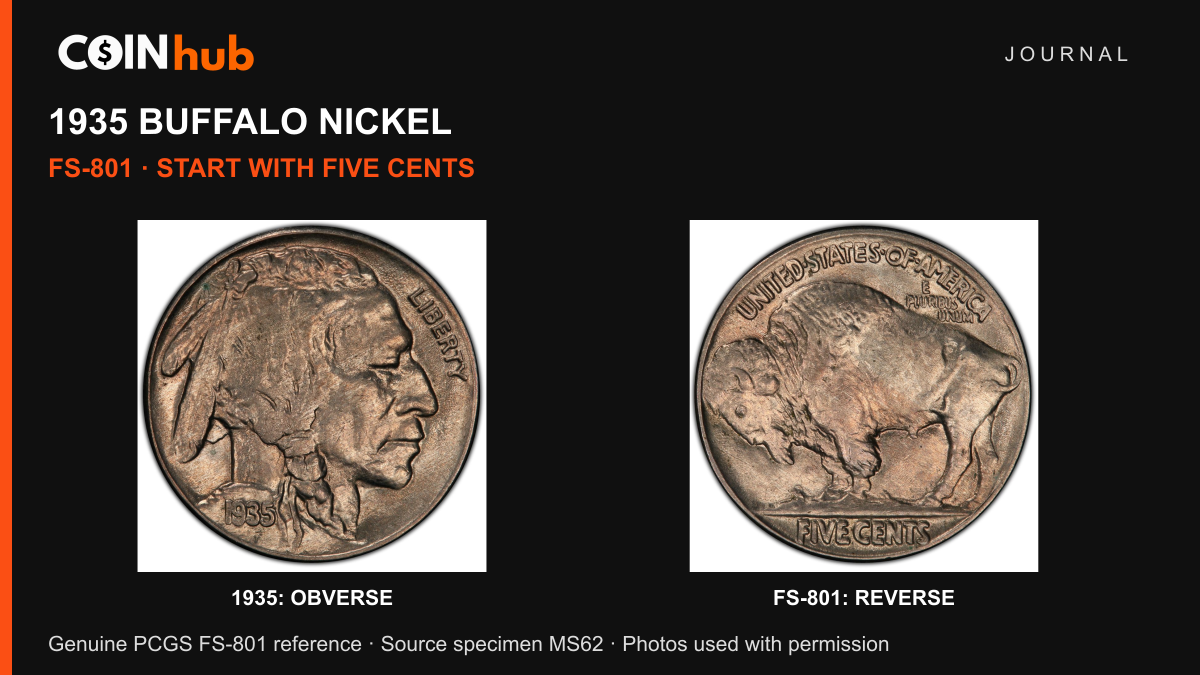
Start with FIVE CENTS on the bison side
The 1935 Buffalo nickel FS-801 is a Philadelphia doubled die reverse variety. Start with the words FIVE CENTS below the bison. Then compare E PLURIBUS UNUM above the animal. PCGS says the doubling is clearest on FIVE CENTS. The motto shows a weaker version.
Check whether the extra edges match that photo. A readable 1935 date, thick letters or an FS number in a sale title cannot settle the attribution. This guide covers the Philadelphia issue pictured here; a different date or mint needs its own reference.
Keep the whole coin tied to the close-up
The main photograph shows both faces of a coin that PCGS catalogs as FS-801. Its source grade is MS62. That grade belongs to the photographed specimen, not another nickel with a similar color or amount of detail.
On the obverse, or front, read the date on the shoulder below the portrait. On the reverse, or back, find FIVE CENTS beneath the bison. Buffalo nickel mint marks, when present, sit below that denomination. The Philadelphia reference has no mint mark there.
Take a full photo of each face before moving in close. That links each close-up to the right coin. If the date or mint area cannot be read, leave that part of the identification open.
Compare the letter shapes, not just their thickness
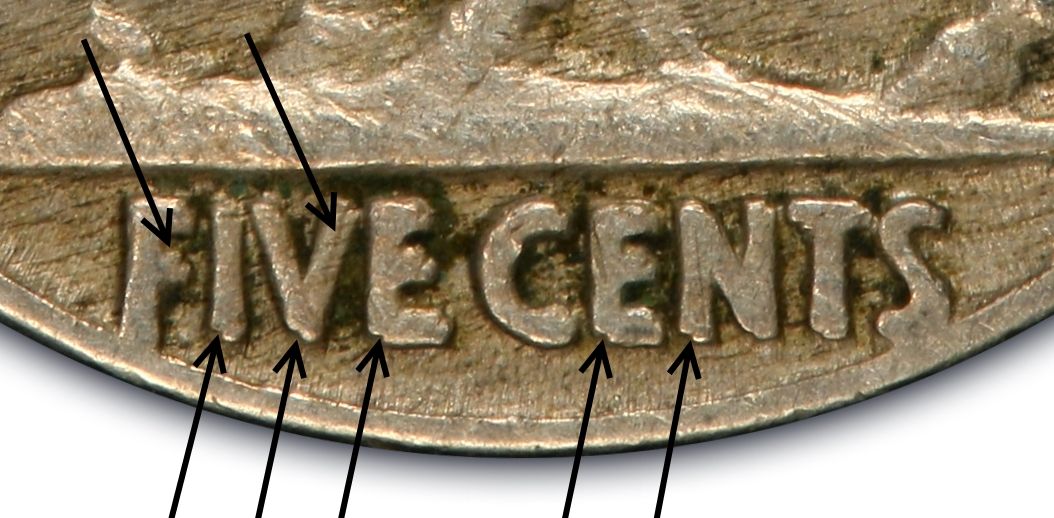
Use the detail photo to follow the edges of several letters across FIVE CENTS. Notice where an extra outline sits in relation to the main letter. Compare its shape and position with your coin. One bright edge in one photograph is a weaker observation than a clear match across several features.
Keep the coin still and take another photo with the light coming from a different direction. This can help separate a surface feature from glare. Do not sharpen the picture until a blurred edge looks like a new line. Save the original photo as well as any crop.
| Area to record | Question to answer |
|---|---|
| Date and mint area | Does this coin belong with the 1935 Philadelphia reference? |
| FIVE CENTS | Do the extra letter outlines match the reference in shape and position? |
| E PLURIBUS UNUM | Does the second comparison support the same identification? |
| Wear or damage | Which details remain visible, and which cannot be judged? |
A doubled die is different from a second strike
A die is the steel tool that stamps a design into a coin. With a doubled die, the repeated detail is in that tool. The name does not mean the finished nickel was struck twice. Our double-struck coin versus doubled-die guide explains the difference.
PCGS also notes another, less dramatic 1935 reverse doubled die. That is a reason to match the specific reference rather than label all reverse doubling FS-801. Wear, a weak impression or surface damage can make comparison harder; uncertainty should stay in the description.
Save an attribution record before discussing a premium
Attribution means matching a coin to a documented variety. Keep the full photos, sharp lettering views, source link and your observations together. Write down what matches and what remains unclear. A note such as “possible FS-801; motto detail obscured” is more useful than an unsupported firm label.
Seek an experienced examination when a purchase or sale depends on the attribution. Leave the surface as found.
For broader background, CoinHub founder Blake Alma's The CoinHub: An Ultimate Guide to Coin Errors is an optional resource. It does not replace the issue-specific photographs needed for this comparison.
Sources and photographs checked October 24, 2026. PCGS photographs used with permission. Old auction results and estimates of surviving coins do not give a current price or a count of this variety.