
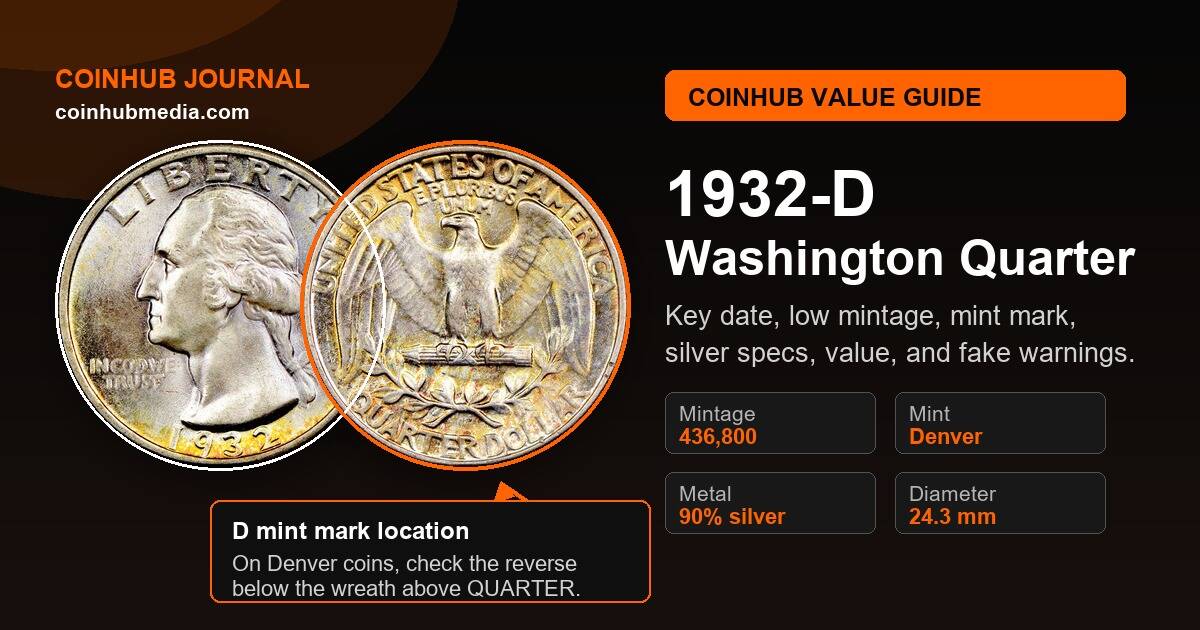
1932-D Quarter Value: Mint Mark, Mintage, and What to Check
Why the 1932-D Quarter Matters
The 1932-D Washington quarter is interesting because it combines three things collectors care about: it is a first-year Washington quarter, it has a very low Denver mintage, and it is a coin that still turns up in old collections often enough for people to search it. The Washington quarter began in 1932 for the bicentennial of George Washington's birth, but the Great Depression sharply reduced demand for new coins. Denver struck only 436,800 pieces, making the 1932-D one of the best-known key dates in the series.
That low mintage does not mean every worn 1932-D is a fortune, but it does mean the coin deserves real attention. A normal 1932 Philadelphia quarter is also collectible as a first-year silver quarter, but the Denver mint mark changes the conversation. The difference between no mint mark and a genuine D mint mark can be the difference between a modest type coin and a key-date Washington quarter.
Where Is the D Mint Mark?
On a genuine 1932-D Washington quarter, the D mint mark is on the reverse of the coin. Look below the wreath and above the word QUARTER. Do not look on the obverse near Washington's portrait, and do not expect a large modern-style mint mark. The mark is small, and on heavily worn coins it may take a good light and magnification to examine properly.
This is also the part of the coin that needs the most caution. Because the 1932-D is valuable, altered coins exist. A common trick is adding a D mint mark to a normal 1932 Philadelphia quarter. Watch for disturbed metal around the mint mark, an odd shape, tool marks, inconsistent toning, or a mark that looks too sharp compared with the rest of the reverse. When the value is high enough to matter, PCGS or NGC authentication is worth considering.
What Is a 1932-D Quarter Worth?
Value depends heavily on grade, surface quality, originality, and certification. According to the NGC Price Guide, as of May 2026, circulated 1932-D Washington quarters are listed across a broad range, roughly from lower circulated values into the high hundreds depending on grade. Mint State examples are a different market entirely, and the jump from an attractive circulated coin to a certified uncirculated coin can be substantial.
PCGS CoinFacts lists the original 1932-D mintage at 436,800 and records a major auction result of $143,750 for a PCGS MS66 example. That kind of price is not a normal expectation for an average coin. It shows what can happen at the very top of the condition scale. Most collectors are dealing with circulated or lower Mint State examples, where condition, cleaning, damage, and authenticity make a major difference.
How to Check One Before Selling or Grading
- Confirm the date is 1932 and the coin is a Washington quarter, not a later silver quarter.
- Check the reverse for a small D mint mark below the wreath and above QUARTER.
- Look for signs the mint mark was added, including scratches, raised metal, or unusual color around the mark.
- Weigh and inspect the coin if something feels wrong. Silver Washington quarters are 90% silver and should not look or feel like modern clad quarters.
- Avoid cleaning the coin. Cleaning can hurt the value even when the coin is genuine.
Common Mistakes Collectors Make
The biggest mistake is assuming every 1932 quarter is a 1932-D. Philadelphia coins have no mint mark, and the 1932-S also has its own separate value profile. Another mistake is trusting a raw key date too quickly. Because the 1932-D and 1932-S are famous, counterfeit and altered examples are part of the market. A bargain price can be a warning sign, especially online.
It is also easy to overestimate grade. A coin that looks "nice" to the eye may still have wear on Washington's hair, cheek, eagle feathers, or high points. Mint State value usually requires no circulation wear, strong luster, and clean surfaces. For a key date like this, small differences in grade can mean large differences in price.
Sources used for coin facts and market context include PCGS CoinFacts, the NGC Coin Explorer and Price Guide, and public-domain 1932 Washington quarter images hosted by Wikimedia Commons from NGC photography.