
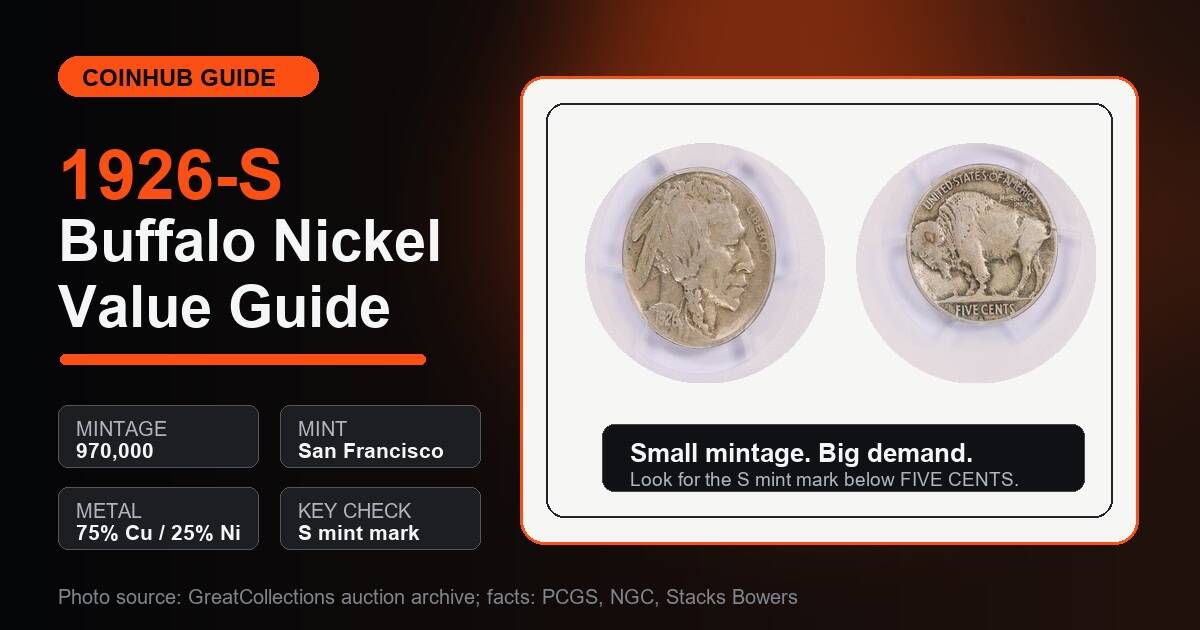
How Much Is a 1926-S Buffalo Nickel Worth?
Why the 1926-S Buffalo Nickel Gets Attention
The 1926-S Buffalo nickel is not a mint error and it is not a variety gimmick. It is a regular-issue coin that became valuable because very few were made and even fewer survived with strong detail. PCGS lists the issue with a mintage of 970,000 pieces, struck at the San Francisco Mint, with James Earle Fraser's classic Buffalo nickel design, a plain edge, 21.20 millimeter diameter, 5.00 gram weight, and copper-nickel composition.
That mintage is the headline number, but the real collector interest comes from condition. Stack's Bowers has described the 1926-S as the smallest-mintage Buffalo nickel and the rarest Buffalo nickel in Mint State. PCGS survival estimates also show why the coin gets serious attention: the public CoinFacts page estimates about 11,000 survivors in all grades, about 500 in Mint State or better, and only about 20 at MS65 or better. Those are estimates, but they explain why a clean, certified example can attract strong demand.
Where to Find the S Mint Mark
To identify a 1926-S Buffalo nickel, look on the reverse. The S mint mark is below the words FIVE CENTS, near the lower rim. A 1926 Buffalo nickel with no mint mark was struck in Philadelphia and is much more common. A 1926-D was struck in Denver. The 1926-S is the one collectors usually search for first because of its lower mintage and key-date status.
On circulated Buffalo nickels, the date and mint mark can be weak or partly worn. That matters. A full, readable date, clear S mint mark, and honest surfaces are much more desirable than a coin where the date was chemically restored or the mint mark is questionable.
1926-S Buffalo Nickel Value by Condition
Values can move with the market, so treat any price guide as a starting point instead of a guaranteed offer. As of June 2026, NGC's public price guide placed circulated 1926-S Buffalo nickels across a wide range, from low double digits for lower grades to several thousand dollars for stronger circulated examples. That wide spread is normal for a key date where small grading differences can matter.
- Heavily worn: The coin may still be collectible if the date and S mint mark are readable, but problems such as corrosion, cleaning, scratches, or a restored date can hold value down.
- Fine to Very Fine: Collectors start paying closer attention when the horn, braid, date, and reverse lettering become easier to see.
- Extremely Fine and About Uncirculated: These grades are much tougher and can bring a strong premium when certified by PCGS or NGC.
- Mint State: This is where the 1926-S becomes a major key-date coin. Luster, strike, marks, and eye appeal all matter, and authentication is strongly recommended.
Grading Details Collectors Check First
Start with the date. The 1926 digits should be readable without relying on harsh enhancement. Next, check the reverse mint mark. The S should sit below FIVE CENTS and match the look of the surrounding metal. On the obverse, look at the Native American's hair braid, cheek, and LIBERTY. On the reverse, look for the buffalo's horn, shoulder, tail, and the rim around FIVE CENTS.
Buffalo nickels often show weak strikes and heavy wear, so do not expect every valuable example to look sharp. Still, the more original detail and surface quality a 1926-S has, the more seriously collectors will treat it. Natural color is usually better than a bright, polished, or oddly shiny surface.
Fake and Altered-Date Warning
Because the 1926-S is a better date, buyers should be careful with raw examples. Watch for added mint marks, altered dates, damaged surfaces, and coins with acid-restored dates being sold as problem-free pieces. A raw 1926-S can be real, but a valuable-looking raw key date deserves extra caution.
If the coin appears high grade, has a very clear S mint mark, or is being priced like a major key-date Buffalo nickel, professional authentication through PCGS or NGC can protect both buyer and seller. A certified holder will not make every coin expensive, but it can remove the biggest question: whether the coin is genuine and accurately graded.
Sources consulted: PCGS CoinFacts, NGC Coin Explorer, Stack's Bowers Coin Resource Center, and GreatCollections auction archive.