
Two portraits on one side, two continents on the other
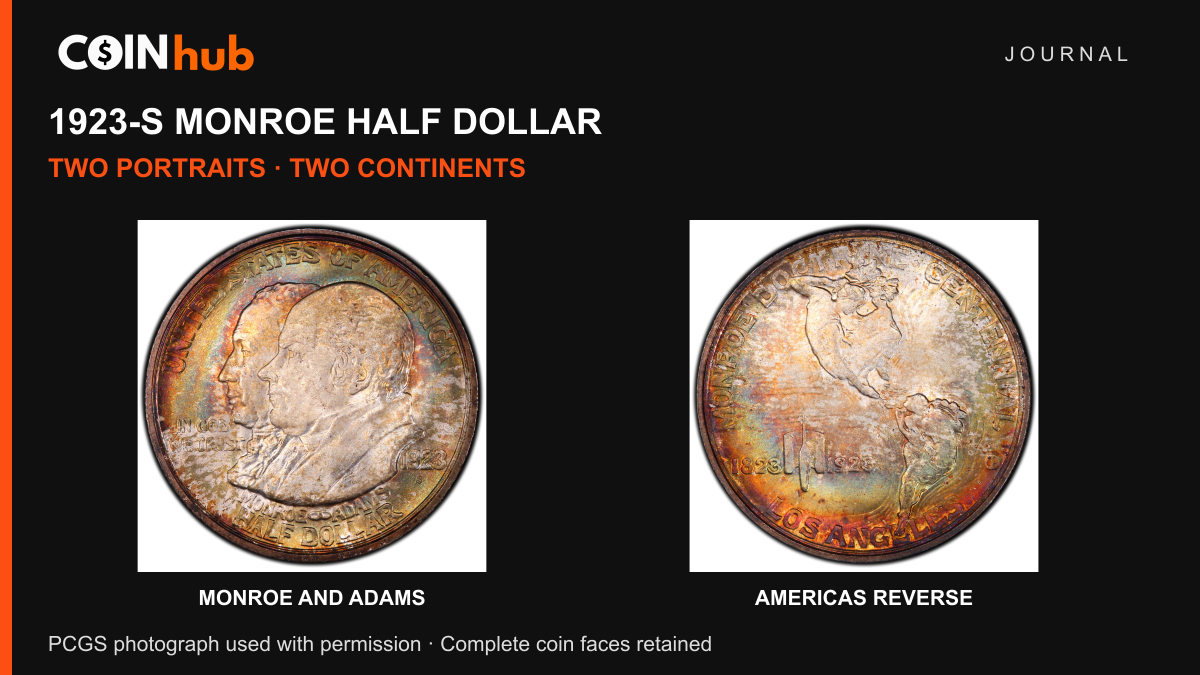
The 1923-S Monroe half dollar shows James Monroe and John Quincy Adams on the front. Its back turns North and South America into two draped human figures. The dates 1823 and 1923 mark a century since the Monroe Doctrine; they are not two issue years.
This is a U.S. commemorative half dollar, a coin made to mark an event. The S identifies the San Francisco Mint. To identify one, read both faces and the small names beneath the portraits before trying to match a sale price.
Put the names beside the faces
The U.S. Mint's official record names Monroe and Adams and credits Chester Beach with both designs. Their names sit below the paired portraits. The issue date 1923 appears nearby, while HALF DOLLAR states the denomination.
Both men served as U.S. presidents, but they had different roles in 1823. Monroe was president and Adams was secretary of state. NGC's historical account connects Adams with the doctrine's text. The two heads do not show two presidents holding office at once.
Follow the map made from two figures
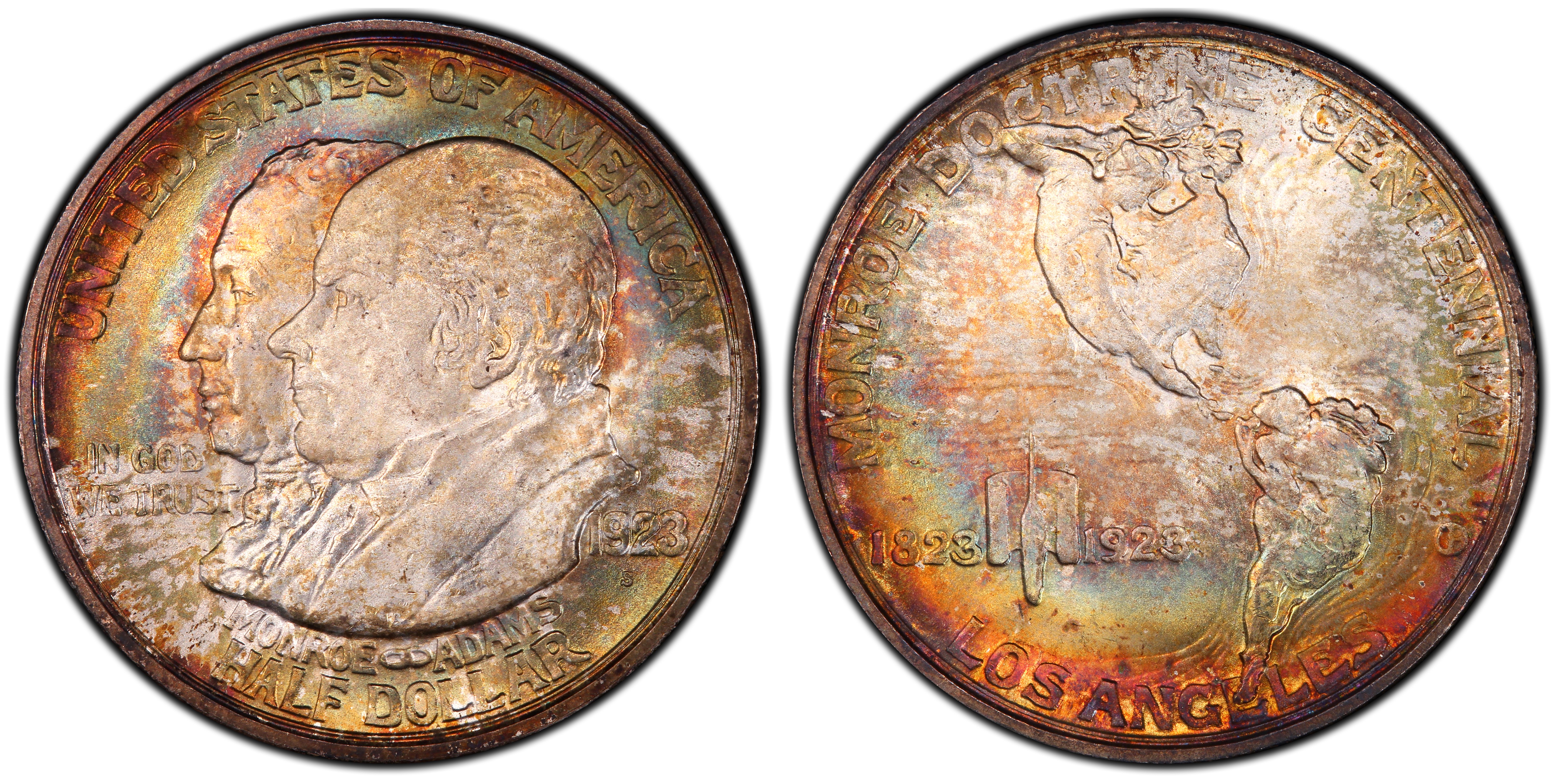
Turn to the reverse, or back. North America occupies the upper part of the design. South America curves down toward the lower right. The figures' outlines help form the continents, so a small view can look more like a map than a pair of people.
The Mint describes the northern figure with a laurel of peace and the southern figure with a horn of plenty. Their hands meet at the Panama Canal. Look at the shapes inside the map as well as its outside edge; that makes the human forms easier to follow.
Below them, a scroll and quill separate 1823 from 1923. LOS ANGELES runs along the lower border. MONROE DOCTRINE CENTENNIAL names the occasion around the upper edge. Those words belong to the original design. They are not later additions simply because the portraits appear on the opposite face.
Keep the anniversary, mint and coin date separate
| What you can read | What it tells you |
|---|---|
| 1923 on the portrait side | The issue year of this commemorative half dollar. |
| 1823–1923 on the map side | The doctrine's centennial span. |
| S beside the portrait-side date | San Francisco, rather than an initial for a president. |
| LOS ANGELES | A design inscription; it does not identify the mint that struck the coin. |
PCGS's CoinFacts entry lists a nominal weight of 12.50 grams, a diameter of 30.60 millimeters and an alloy of 90% silver and 10% copper. These are reference specifications. Matching a weight alone does not prove that a piece is genuine.
Read the design before judging the surface
In the reference photo, the portrait faces have broad, low areas, while the map contains small overlapping shapes. Some details can be hard to read even in a large picture. Flat-looking design, weak detail, wear and glare are different possibilities; one photograph cannot always separate them.
Take full-face photos before close-ups. Record where a detail is unclear rather than calling the whole coin worn from one pale patch. Do not polish a toned surface to make the faces or map stand out. Cleaning can change the evidence you want someone else to examine.
When researching value, compare the same issue and condition with sales that actually took place. A record price for an unusually fine coin is not a price for every Monroe half dollar. This guide makes no current value claim.
For another small feature with a different meaning, compare CoinHub's Grant half dollar's star and no-star designs. Each commemorative has its own date story; a mark on one issue does not explain a mark on another.
Official design record, historical context, specifications and photograph checked October 28, 2026. PCGS photograph used with permission. CoinHub proportionally framed the complete coin faces and added labels without altering their details or color.