
How Much Is a 1921 High Relief Peace Dollar Worth?
Why the 1921 Peace Dollar Is Special
The 1921 Peace dollar is one of the most interesting silver dollars a collector can pull out of a box, estate, or old collection. It was the first year of Anthony de Francisci's Peace dollar design, and it was struck in high relief before the Mint lowered the design for regular production in 1922. That makes the 1921 issue a one-year type coin for many collectors, not just another date in the Peace dollar set.
Production also happened in a very short window. PCGS notes that the full circulation-strike mintage was struck during the last days of December 1921, and CoinWeek reports that the coins were released to the public in early January 1922. Because collectors like first-year coins, high-relief designs, classic silver dollars, and low-mintage issues, demand for the 1921 Peace dollar stays strong even in lower grades.
How To Identify a 1921 Peace Dollar
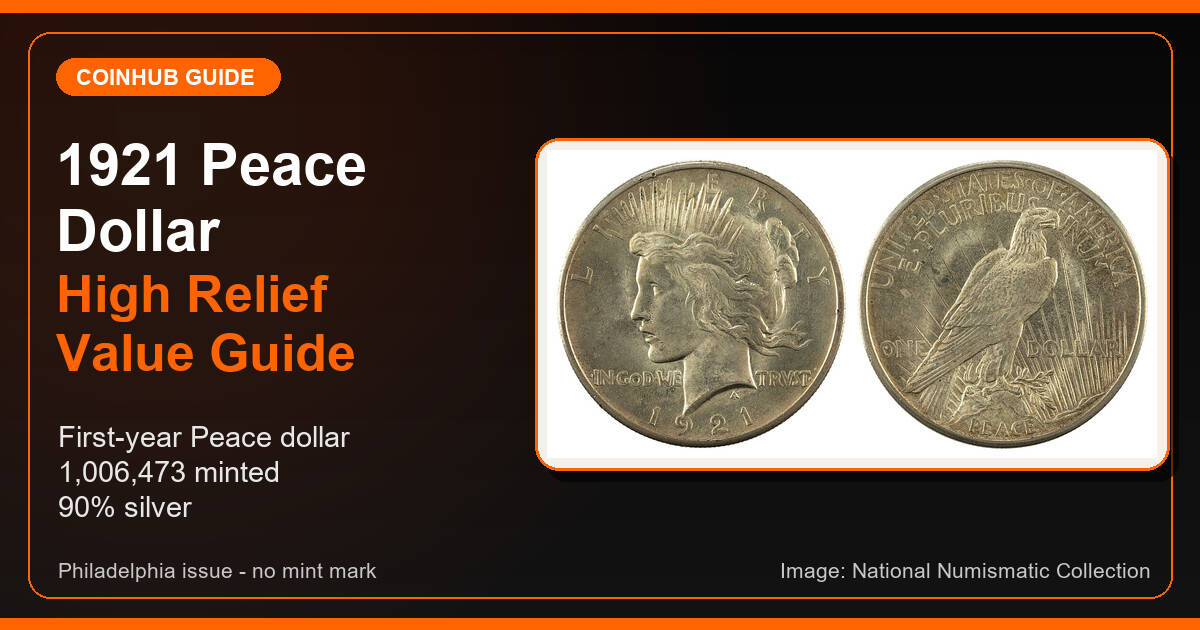
Every regular 1921 Peace dollar was struck at the Philadelphia Mint, so it should not have a mint mark. On later Denver and San Francisco Peace dollars, the mint mark appears on the reverse below the word ONE and above the eagle's tail area. For 1921, the correct answer is no mint mark.
The high-relief look is the main design feature. The devices rise more dramatically from the fields than on most 1922-1935 Peace dollars, and the obverse fields often look slightly more concave. PCGS also points to thicker rays from Liberty's head and different reverse ray and mountain details when compared with later low-relief pieces. If you are comparing one in hand, set it next to a common 1922 or 1923 Peace dollar and the sculptural difference is easier to see.
Value: Grade and Surface Matter
Do not price a 1921 Peace dollar like a common silver dollar. It contains about 0.7734 troy ounce of pure silver, but collector value normally dominates melt value. NGC's price guide has recently placed circulated 1921 Peace dollars broadly in the $100 to $525 range, while CoinWeek has described typical circulated examples around the low hundreds and certified MS63 examples around the $1,000 area. Very high-grade certified coins can go much higher, especially when the strike is sharp and the surfaces are original.
That range is intentionally broad because grading changes everything. A cleaned VF coin, a problem-free XF coin, a sharp AU coin, and a certified MS64 coin are not the same market. Eye appeal also matters. Many 1921 Peace dollars show weakness in Liberty's hair and the eagle's feathers because the high-relief design was difficult to strike. A sharper-than-average coin can bring a premium, while cleaning, polishing, rim damage, or artificial toning can hurt value quickly.
Common Mistakes Collectors Make
- Thinking every Peace dollar is worth about the same. The 1921 high relief is a much better date than most common 1922-1925 pieces.
- Assuming "no mint mark" is an error. For 1921, no mint mark is normal because the coins were made in Philadelphia.
- Ignoring cleaning. Bright, hairlined, overly shiny silver dollars are common, and cleaning can reduce what a buyer will pay.
- Buying raw high-dollar examples without authentication. Better 1921 Peace dollars should usually be certified by PCGS, NGC, or another respected service.
Fake and Alteration Warning
The 1921 Peace dollar is valuable enough that collectors should be careful with raw pieces. Check the weight, diameter, edge, and overall design sharpness. A genuine coin should weigh about 26.73 grams, measure 38.1 mm, have a reeded edge, and show the proper 90% silver composition. Counterfeits may have mushy details, incorrect color, odd surfaces, wrong weight, or design details that do not match known genuine examples.
If the coin looks valuable, do not clean it before showing it to a dealer or grading service. Original surfaces are part of the value. When in doubt, compare it with certified examples and have it reviewed in person before making a buying or selling decision.