
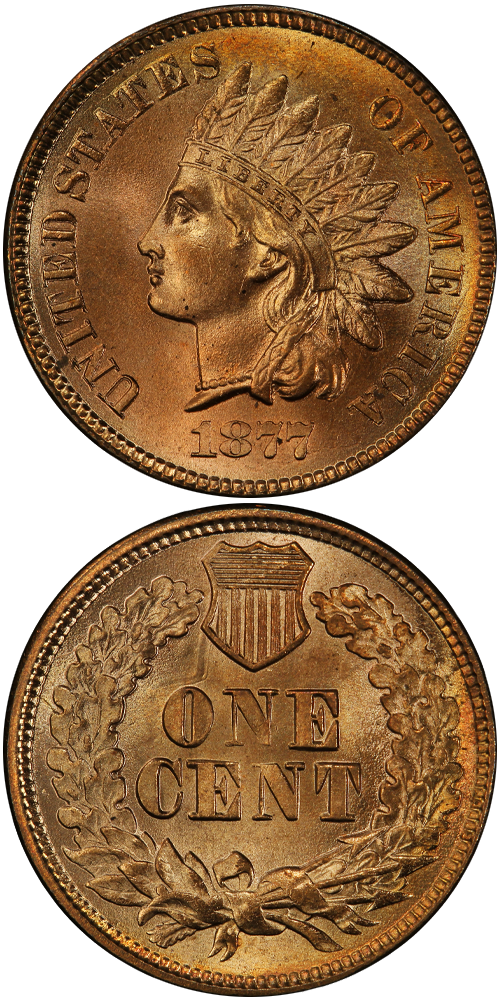
1877 Indian Head Cent Value, Rarity, and Fake Warning
The 1877 Indian Head penny is the key circulation-strike date of the Indian Head cent series. Problem-free circulated examples often sell for hundreds to several thousand dollars depending on grade, while Mint State Red examples can reach five figures or more.
The 1877 Indian Head penny is one of the first coins collectors ask about when they inherit an old cent collection. It is not valuable because it is an error. It is valuable because it is a scarce regular-issue Philadelphia cent from a year when very few new cents were needed for circulation.
PCGS lists the 1877 Indian cent with a mintage of 852,500 pieces, a plain edge, 19.00 millimeter diameter, 3.11 gram weight, and a bronze composition of 95% copper with 5% tin and zinc. Stack's Bowers also lists the circulation mintage at 852,500 and explains that 1877 cents are tougher than the mintage alone suggests because many went into commerce instead of being saved by collectors.
Why the 1877 Indian Head Penny Is So Valuable
The 1877 cent is famous because it combines low availability with heavy collector demand. The 1909-S Indian Head cent has a lower mintage, but the 1877 is often considered tougher in circulated grades because fewer collectors were setting aside business-strike Indian cents in 1877. By the time the series became more widely collected, many 1877 cents had already spent years in use.
That history matters for value. A worn but genuine 1877 cent can still be an important coin, especially if it has natural surfaces, a readable date, and no serious corrosion. Cleaned, scratched, bent, pitted, or recolored examples can still have value, but they usually sell for less than problem-free coins of the same sharpness.
How To Identify a Real 1877 Indian Head Cent
What Is an 1877 Indian Head Penny Worth?
Value depends heavily on grade, color designation, originality, and certification. Low-grade but genuine examples can sell for several hundred dollars, mid-grade circulated coins can move into the low thousands, and attractive Extremely Fine to About Uncirculated coins can bring significantly more. Mint State Brown, Red-Brown, and especially full Red examples are much scarcer and can sell for many thousands.
Top-end coins are a different market. PCGS records an auction record of $149,500 for an MS66 example, while Stack's Bowers notes a high-grade example that realized $99,875 in a 2015 sale. Those numbers should not be used for ordinary circulated coins, but they show why the date is so closely watched by serious Indian Head cent collectors.
Should You Grade an 1877 Indian Head Penny?
If you believe you have a genuine 1877 Indian Head cent, professional authentication is usually worth considering. This is a heavily counterfeited and altered-date coin, and the difference between a real 1877, an altered date, and a damaged coin can be hundreds or thousands of dollars. PCGS or NGC certification can also make the coin easier to sell because buyers can judge the grade and authenticity more confidently.
Common Mistakes Collectors Make
The biggest mistake is assuming every old Indian Head cent is rare. Most dates from the series are much more common than 1877. Another mistake is judging value from one extreme auction result online. Condition is everything. A corroded or harshly cleaned 1877 is not valued like a certified Mint State Red coin, even though both have the same date.
CoinHub tip: If you find an 1877 Indian Head penny, avoid cleaning it, rubbing the date, or trying to improve the color. Put it in a holder, compare the date carefully, and get an expert opinion before selling or sending it for grading.