
How Much Is an 1870-CC Seated Liberty Dollar Worth?
Why the 1870-CC Dollar Is Interesting
The 1870-CC Seated Liberty dollar is one of those coins that combines history, low supply, and strong collector demand in a very direct way. It was struck at the Carson City Mint during the first year that facility produced silver dollars, which gives it extra appeal beyond the normal date-and-mintmark checklist. Carson City coins already have a built-in following because of their connection to western silver mining, and a large 90% silver dollar with a bold CC mint mark is the kind of coin collectors remember.
You may see two different mintage numbers for this issue. PCGS notes that original monthly Mint records point to 11,758 pieces, while the long-used published figure is 12,462. Stack's Bowers and many collector references still use 12,462. Either way, the number is tiny for a circulating U.S. dollar, and survival is much lower than the original mintage. Stack's Bowers estimates about 550 to 675 survivors in all grades, with far fewer in About Uncirculated and Mint State.
How to Identify an 1870-CC Seated Liberty Dollar
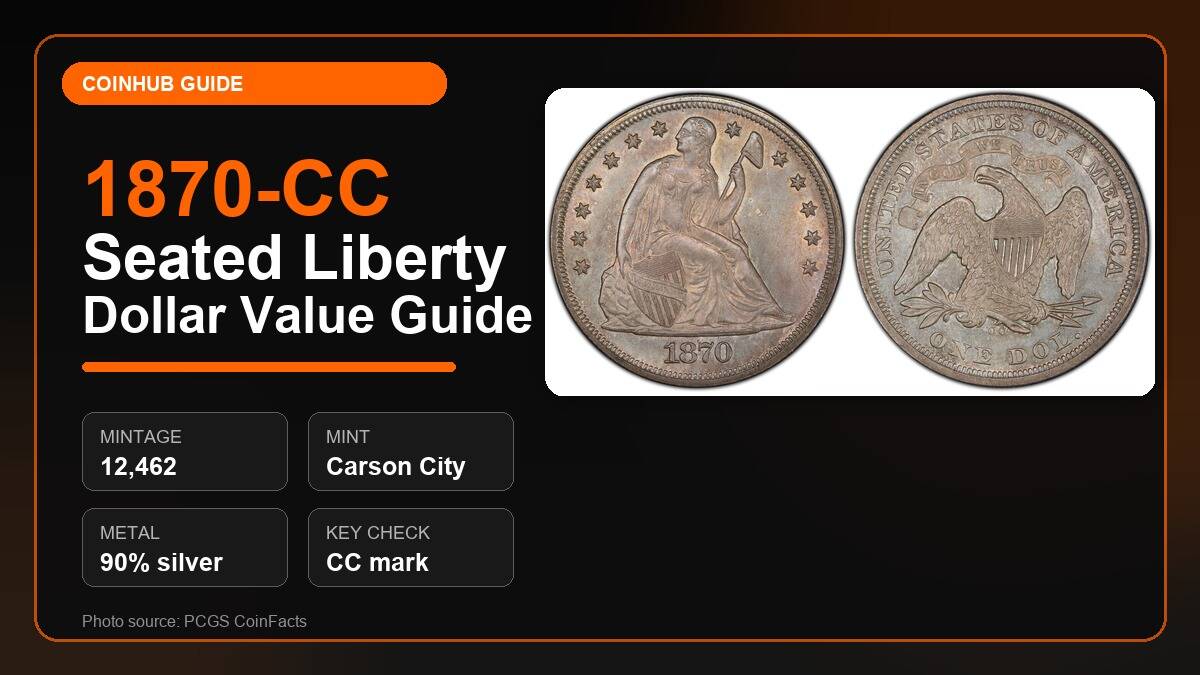
The obverse shows Liberty seated on a rock, holding a shield and pole, with the date 1870 at the bottom. The reverse has an eagle with shield, the motto IN GOD WE TRUST on a ribbon above the eagle, and the denomination ONE DOL. near the bottom. The most important detail is the CC mint mark. On a genuine 1870-CC Seated Liberty dollar, the CC appears on the reverse below the eagle and above ONE DOL.
Basic specifications are helpful for screening a raw coin before you get too excited. The coin should weigh about 26.73 grams, measure 38.10 mm in diameter, have a reeded edge, and contain 90% silver and 10% copper. A badly underweight piece, wrong edge, strange diameter, or soft details around the CC mint mark should be treated as a warning sign.
1870-CC Seated Liberty Dollar Value by Grade
Values can move with the market, but this is not a coin where small differences in grade are trivial. A heavily worn but problem-free certified example can still be worth thousands. NGC's June 2026 price guide range places circulated 1870-CC Seated Liberty dollars roughly between $1,000 and $23,000 depending on grade. APMEX shows guide levels moving from low four figures in Good and Very Good to much higher numbers in Extra Fine, About Uncirculated, and Mint State. USA Coin Book also places average circulated examples around the low four-figure range, with uncirculated examples far higher.
Surface quality matters almost as much as grade. Cleaning, scratches, rim damage, corrosion, artificial toning, or a questionable mint mark can push a coin below the value of a straight-graded example. On the other hand, an attractive certified coin with original surfaces can bring strong bids because collectors building Carson City dollar sets do not have many choices.
Common Mistakes and Fake Warnings
The biggest mistake is treating every old Seated Liberty dollar like it is the Carson City issue. Philadelphia coins from 1870 do not have the CC mint mark. Another mistake is focusing only on silver melt value. The silver content is real, but the collector value is the story here. A genuine 1870-CC dollar is worth far more than its bullion value in almost any collectible grade.
Counterfeits and altered mint marks are also a real concern. Because the CC mint mark creates so much value, buyers should be careful with raw examples, online listings, and coins that look unusually cheap. For a coin like this, PCGS, NGC, or another respected authentication route is not just a nice extra. It can be the difference between buying a rare Carson City dollar and buying an expensive problem.
Should You Grade One?
If you believe you have an 1870-CC Seated Liberty dollar, professional authentication is usually worth considering. Do not clean it, dip it, polish it, or try to improve the look before getting an opinion. Take clear photos of both sides, including a close view of the CC mint mark, and compare the weight, diameter, and design details against certified examples.
Primary references checked: PCGS CoinFacts, Stack's Bowers Coin Resource Center, NGC Coin Explorer, APMEX, and USA Coin Book. Values are guide estimates and market prices can change.