
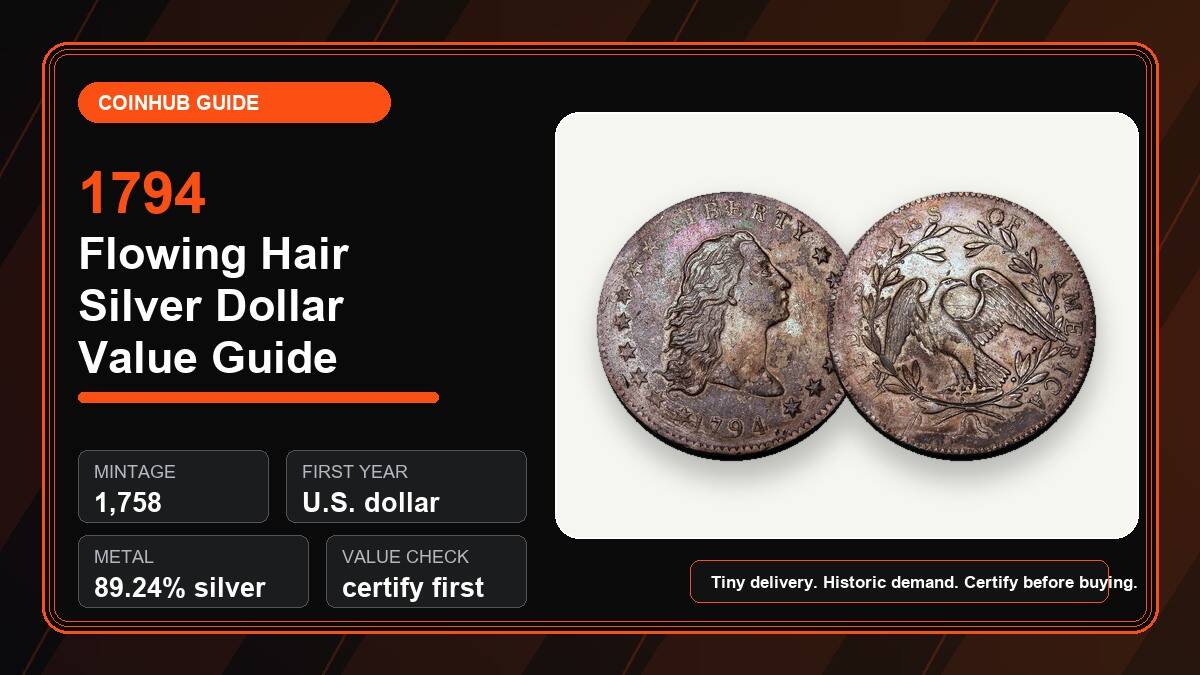
How Much Is a 1794 Flowing Hair Silver Dollar Worth?
Quick answer: a genuine 1794 Flowing Hair silver dollar is a major trophy coin, not a normal silver-dollar find. Recent PCGS guide levels place even low-grade examples in six-figure territory, while Mint State coins can reach seven figures or more. The biggest drivers are authenticity, grade, surface quality, strike, and whether the coin has famous provenance or the rare silver-plug distinction.
The 1794 Flowing Hair silver dollar is one of the most important coins in United States history because it represents the first year the U.S. Mint struck silver dollars. The design shows Liberty with flowing hair on the obverse and an eagle inside a wreath on the reverse. The U.S. Mint notes that the first silver dollars were struck on October 15, 1794, and that only 1,758 pieces were made for the year.
That tiny delivery is only part of the story. PCGS lists an estimated survival of about 150 pieces in all grades, with far fewer in Mint State. Stack's Bowers gives a similar collector-focused estimate of roughly 135 to 150 survivors. In other words, this is the kind of coin where even a damaged or heavily worn genuine example can still be historically important.
1794 Flowing Hair Dollar Value Ranges
Values change with the market, and auction results can move quickly for elite early dollars. As of the PCGS Price Guide update shown on June 26, 2026, the 1794 Flowing Hair dollar carried guide levels around $115,000 in Good-4, $275,000 in Fine-12, $475,000 in Extremely Fine-40, $925,000 in About Uncirculated-55, $1.25 million in MS-60, $4.5 million in MS-63, and $8.5 million in MS-66. Those are guide figures, not offers, but they show the scale of demand.
| Grade Area | What It Means For Value |
|---|---|
| Good to Fine | Still a six-figure rarity when genuine, especially if surfaces are problem-free. |
| Extremely Fine to AU | Sharp details, stronger surfaces, and better eye appeal can push values much higher. |
| Mint State | These coins are elite auction pieces, often discussed in seven-figure terms. |
| Silver Plug / special provenance | The finest special examples can separate from normal price-guide logic entirely. |
How To Identify a Real 1794 Flowing Hair Dollar
A genuine 1794 Flowing Hair dollar should have the date 1794 below Liberty, the word LIBERTY above her head, and 15 stars around the obverse. The reverse has UNITED STATES OF AMERICA around an eagle and wreath. The edge is lettered with HUNDRED CENTS ONE DOLLAR OR UNIT, and the coin was struck at Philadelphia with no mint mark.
The early dollar standard was 40 millimeters in diameter, about 26.96 grams in weight, and 89.24% silver with 10.76% copper. Many real examples show weakness toward the left side because the early Mint press struggled with a silver coin this large. Some also show adjustment marks from hand filing the planchet to bring the weight into tolerance. These details can be normal, but they are not enough to prove authenticity by themselves.
Why Authentication Matters So Much
Because the value is so high, replicas, altered pieces, and fantasy copies are a real risk. Do not rely on a quick photo comparison, a magnet test, or a story about an old family collection. For a coin with this level of value, third-party certification from a major grading service is the practical starting point. Provenance also matters because many known examples have long ownership histories.
CoinHub tip: if someone offers a raw 1794 Flowing Hair dollar, treat the authentication process as the value. Clear photos, exact weight, exact diameter, edge lettering, surface condition, and professional certification should come before any price conversation.
Bottom Line
The 1794 Flowing Hair silver dollar is not just an old dollar coin. It is the beginning of the U.S. silver dollar series and one of the most recognized rarities in American coin collecting. A real example can be worth life-changing money, but condition and authentication decide the result. If you think you have one, slow down, protect the coin, and get expert review before cleaning, selling, or sending it anywhere.
Sources consulted: PCGS CoinFacts, PCGS Price Guide, U.S. Mint Flowing Hair history, and Stack's Bowers Coin Resource Center.