
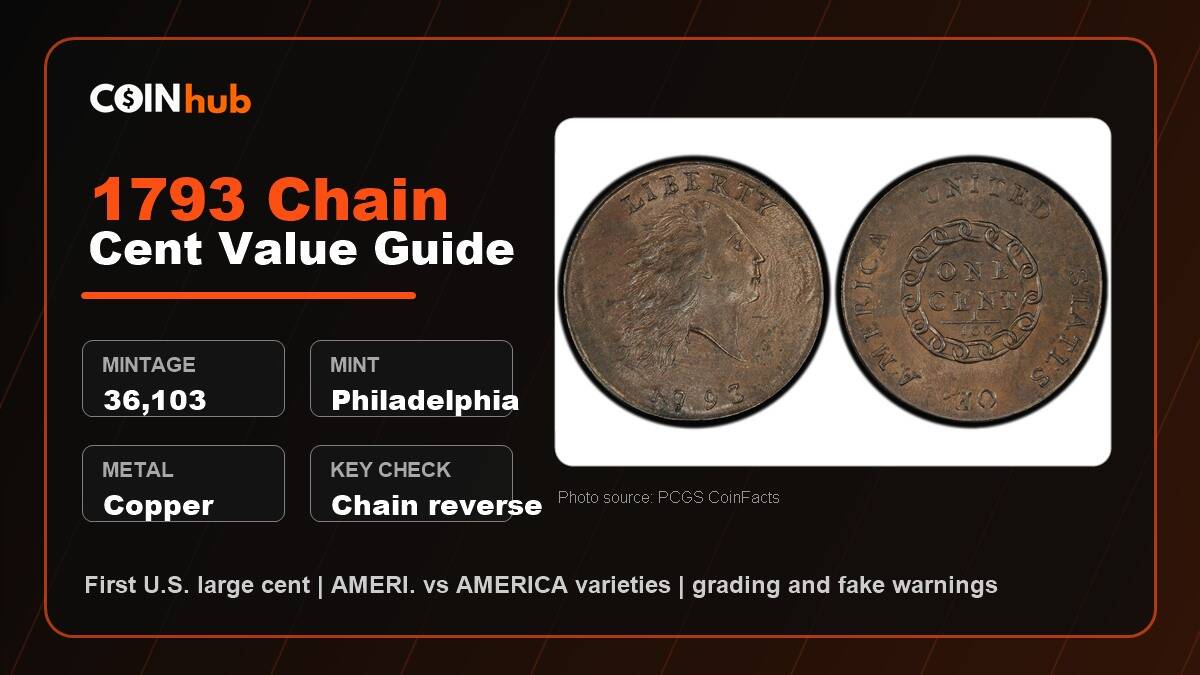
1793 Chain Cent Value: Why This First U.S. Large Cent Matters
Quick answer: A genuine 1793 Chain cent is a major U.S. copper rarity. Even heavily worn examples can sell for thousands of dollars, while problem-free coins with strong details can climb into the tens of thousands. Variety, surface quality, and third-party authentication matter more than a simple date check.
The 1793 Chain cent is one of those coins that feels bigger than its denomination. It is only worth one cent by face value, but historically it represents the beginning of the federal large cent series and one of the earliest regular issues struck by the United States Mint in Philadelphia. Collectors search for it as a first-year type coin, an early copper rarity, and a piece of American Mint history.
How much is a 1793 Chain cent worth?
Value depends heavily on grade, surfaces, and whether the coin is straight-graded or has problems such as corrosion, scratches, cleaning, damage, or environmental issues. As a broad collector guide, PCGS price-guide levels for the 1793 Chain, AMERICA variety show values moving from several thousand dollars in the lowest collectible grades to around five figures in Good and Very Good levels, then much higher in Fine, Very Fine, Extremely Fine, and About Uncirculated grades.
A coin with honest wear but readable major details can still be valuable because demand is strong and survivors are limited. A sharper coin with smooth brown surfaces is usually far more desirable than a coin with the same detail but heavy corrosion or tooling. For a coin this important, price should be based on authenticated grade, variety attribution, eye appeal, and recent auction records.
AMERI. vs AMERICA varieties
One of the most searched parts of the 1793 Chain cent is the reverse legend. Some examples show the country abbreviated as AMERI., while others spell AMERICA more fully around the chain reverse. The AMERI. reverse is especially famous because it belongs to the earliest Chain cent variety and is often discussed as part of the first federal cent delivery.
That does not mean every 1793 Chain cent is the same. Specialists attribute these coins by Sheldon variety, reverse lettering, date spacing, die cracks, and other small diagnostics. If you think you have one, do not rely on a quick online photo match alone. A professional attribution can change the value picture dramatically.
How to identify the coin
The obverse shows Liberty facing right with flowing hair, the word LIBERTY above, and the 1793 date below. The reverse is the reason for the nickname: a chain surrounds ONE CENT and the fraction 1/100. The edge is also important, with a bars-and-vines design rather than a plain modern edge.
- Look for a large copper cent, not a small modern penny.
- Check for the chain reverse and the ONE CENT center text.
- Confirm the Philadelphia issue has no mint mark.
- Compare the reverse legend: AMERI., AMERICA, or periods variety.
- Weighing and edge inspection should be handled carefully to avoid damage.
Why authentication matters
Because a real 1793 Chain cent can be worth serious money, the market has copies, altered coins, damaged genuine pieces, and fantasy reproductions. Some replicas are obvious, but others are deceptive in photos. The safest move is to have a suspected example reviewed by a trusted coin professional and, when the coin appears promising, submitted to a major grading service such as PCGS or NGC.
Be extra cautious with unusually cheap listings, blurry photos, coins with strange color, incorrect weight, soft lettering, or missing edge detail. Early copper is also vulnerable to surface problems, so a coin can be genuine and still trade at a discount if it has corrosion or cleaning.
CoinHub tip: If you believe you found a 1793 Chain cent, treat it like a serious numismatic item immediately. Do not clean it, do not test it harshly, and do not sell it based only on a quick photo opinion. Authentication and variety attribution are the key steps before placing a value on the coin.
Sources consulted: PCGS CoinFacts, Stack's Bowers large cent references, and CoinWeek historical background. Photo source for article graphic: PCGS CoinFacts.